Most visitors meet the LU biscuit long before they meet Nantes itself, usually in the biscuit aisle of a French supermarket, in the blue-and-gold wrapper of a petit-beurre. What they often don't realize is that the factory that made it famous still stands on the banks of the Loire, and that its best-known landmark, a tower, was demolished by the company that built it and then, decades later, rebuilt by the city that inherited the ruins. It's an odd little story, and it says a lot about how Nantes treats its industrial past: not as something to erase, but as something to argue with, lose, and eventually patch back together.
A biscuit with a shape everyone can draw
LU stands for Lefèvre-Utile, the surnames of the couple, Jean-Romain Lefèvre and Pauline-Isabelle Utile, who took over a small Nantes bakery in the mid-19th century and turned it into an industrial biscuit maker. Their son Louis Lefèvre-Utile pushed the business further, hiring well-known poster artists for advertising and building a factory on the Loire that was meant to be seen, not hidden. The petit-beurre, with its scalloped edge and 24 corner teeth, became the company's signature and is still one of the most recognizable biscuit shapes in France. Whether or not the teeth and corners were ever meant to symbolize specific things, as souvenir shops sometimes suggest, is the kind of claim worth taking with a grain of salt; what's certain is that the biscuit's outline has barely changed since the 19th century, which is itself unusual.
By the early 20th century LU was exporting biscuits well beyond France, and the Nantes factory had grown into a genuine industrial complex along the river, visible from boats and from the opposite bank. It was not a discreet building. Twin towers, dressed up with a faintly medieval, castle-like silhouette, gave the factory a skyline of its own, something closer to a folly than a biscuit plant.
The factory, the towers, and what got torn down
The factory kept working through most of the 20th century, but by the early 1970s the company needed to modernize the site, and one of the two towers was knocked down to make way for new production lines. It was a practical decision at the time, the kind of trade-off industrial cities made constantly, and nobody expected it to become a local sore point. But as LU eventually moved its manufacturing elsewhere and the Nantes site wound down as a working factory, the missing tower became harder to ignore, a visible gap in a skyline people had grown attached to without quite noticing.
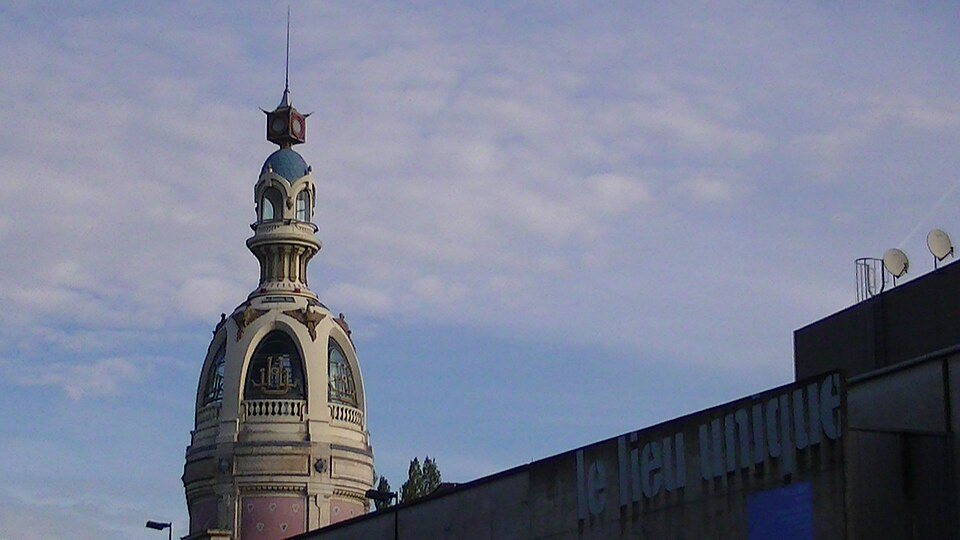
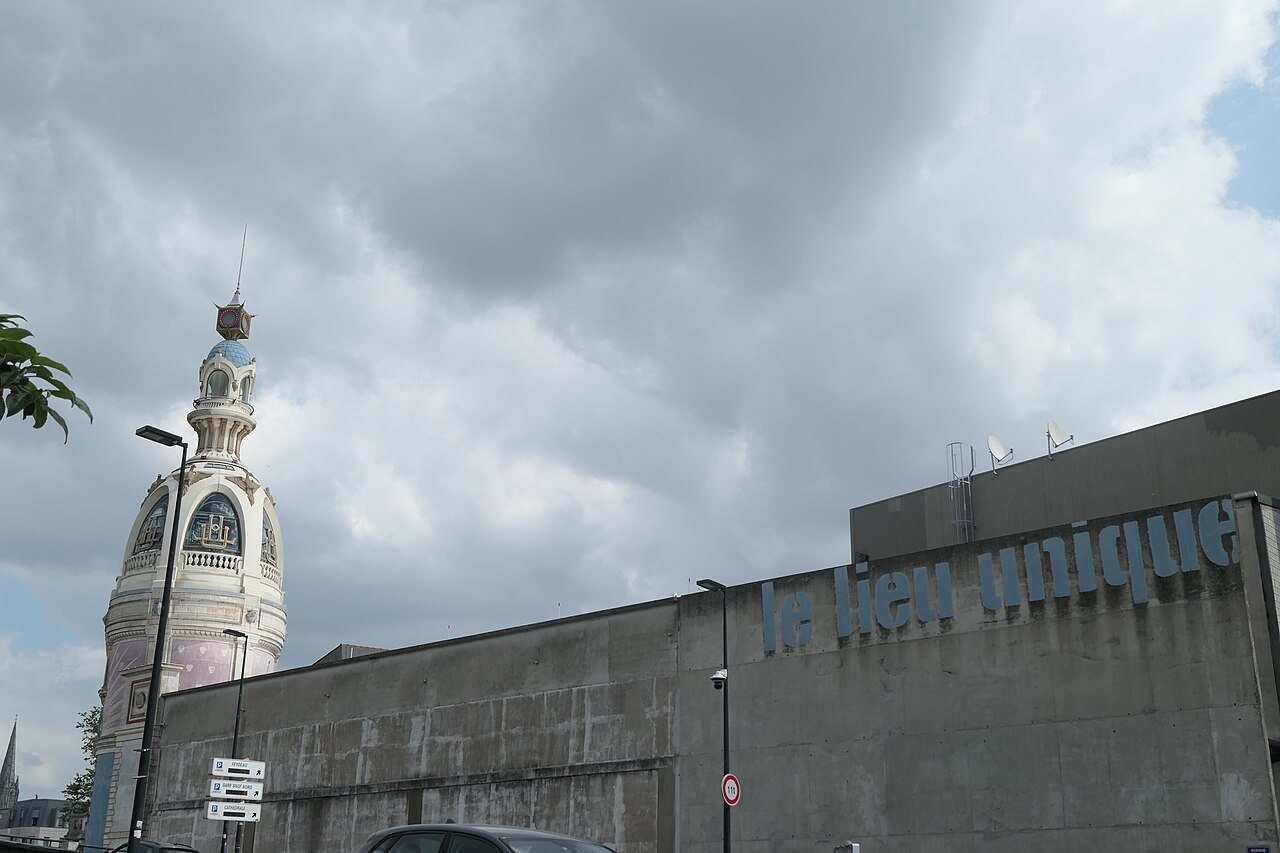
When the city and a group of artists and architects took over the remaining buildings in the late 1990s to turn them into a cultural venue, the question of the lost tower came up directly. Rather than leave the asymmetry as found, the renovation project, led by architect Patrick Bouchain, rebuilt the missing tower as part of the new complex. It isn't a strict replica in the way a historic preservation board might insist on, and it isn't hidden that it's new construction grafted onto old brick. That honesty is part of the point: the rebuilt tower doesn't pretend the demolition never happened, it just refuses to let the gap be permanent.
Lieu Unique: what the factory became
The result is Lieu Unique, now one of the more unusual cultural venues in western France, built directly into the old biscuit works. The industrial bones are left visible on purpose: exposed brick, old structural ironwork, the scale of rooms clearly designed for machinery rather than people. It functions today as a multidisciplinary arts space, with a program that shifts between performance, exhibitions, and public events, plus a bar and a bookshop that make it an easy stop even if nothing is scheduled the day you visit. The rebuilt tower, which you can climb, gives a view over the factory roofs and the Loire that the original builders would probably recognize.
For checking what's actually on, concerts, talks, installations, since the program changes often and isn't something a guidebook can responsibly pin down, go directly to the venue's own listings rather than relying on a secondhand schedule.
Tasting the thing itself
LU biscuits are no longer made in Nantes, production moved on long ago, so this isn't a factory-tour-then-snack situation the way some food destinations work. What you can still do is taste the product with some local context: petit-beurre, the butter wafer, and Paille d'Or are all sold everywhere in Nantes, from supermarkets to small groceries, and pastry shops around the city sometimes riff on the petit-beurre shape or flavor as a nod to the local connection. It's worth asking in a pâtisserie near the Bouffay quarter or around place Graslin whether they do anything LU-inspired; some do, informally, without making a big production of it.
If you want the fuller picture of Nantes as an industrial river port, not just biscuits but shipping, sugar, and the slave trade that financed much of the city's 18th-century wealth, the port and memory guide and the memorial to the abolition of slavery nearby fill in the harder history that the biscuit story tends to skip past. LU is a lighter chapter, but it belongs to the same riverbank, and the rebuilt tower is as good a place as any to stand and look at the water that carried both the sugar and the biscuits away.
Practical notes
- Lieu Unique sits close to the train station, making it an easy add-on to a day that also covers the Château des ducs de Bretagne or a walk through Quai de la Fosse.
- The tower climb and any temporary exhibitions are subject to the venue's own access rules, which change with each program, so confirm directly with Lieu Unique before planning a visit around them.
- If you're tracing Nantes by tram, the stop nearest the building connects easily to the rest of the tramway network, making this a reasonable stop on the way to or from the Hangar à Bananes further down the river.
In pictures