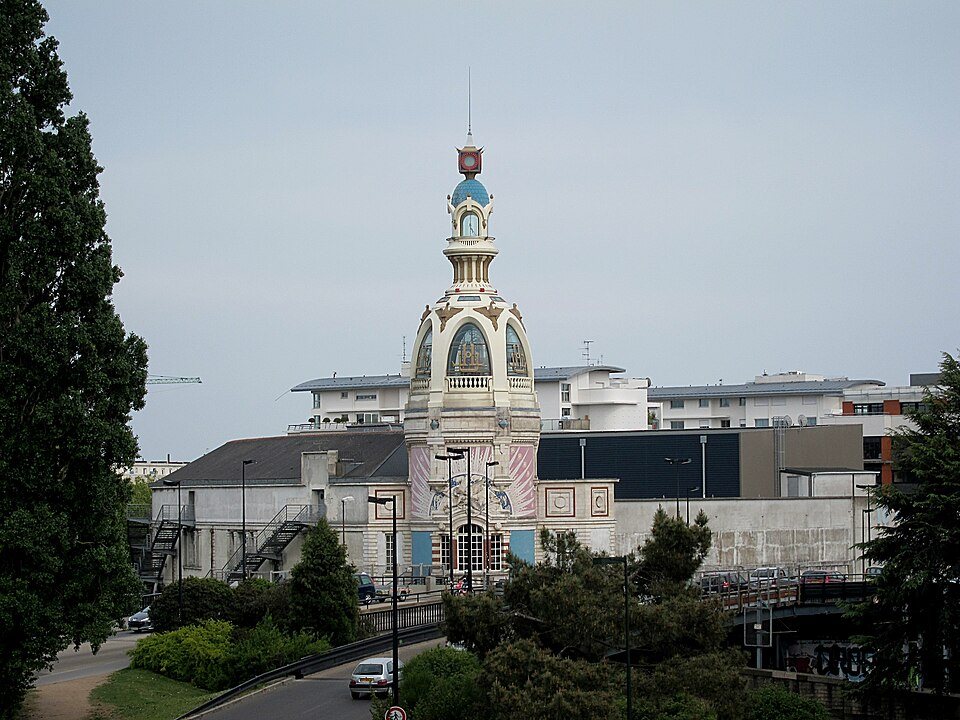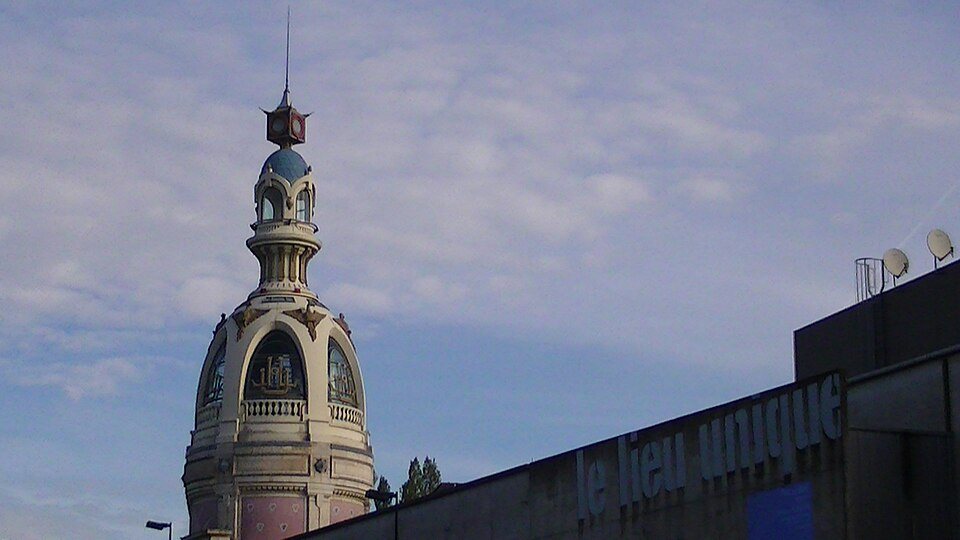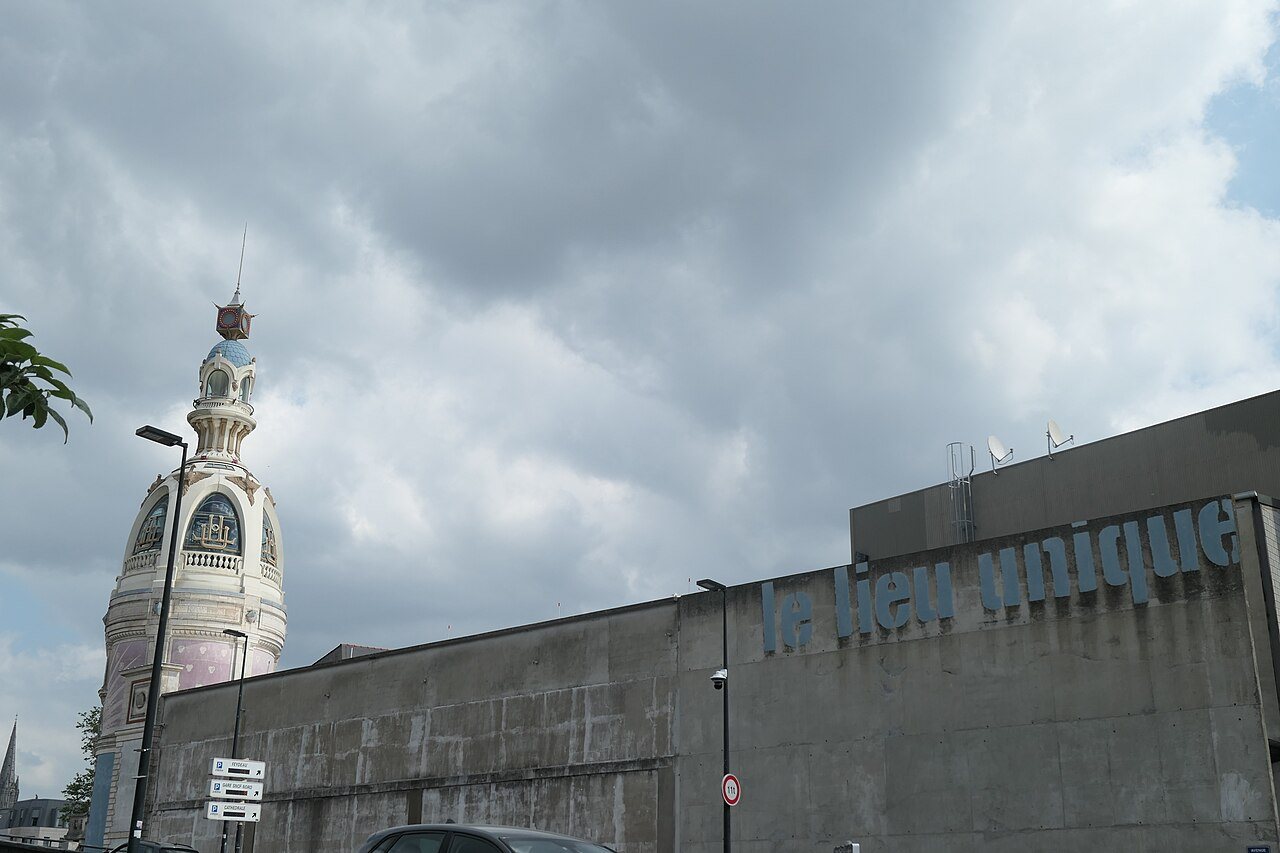
LU — Lefèvre-Utile — made its biscuits here, and the Petit-Beurre is a Nantes invention. The factory had two ornate towers; one was demolished, and the survivor was restored and put back with its dome and its winged figure.
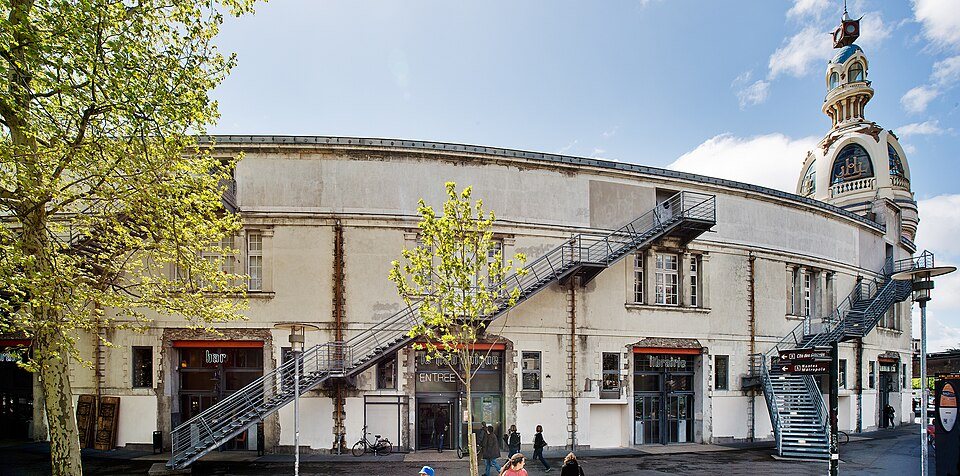
The building is now a lieu unique: a venue with a theater, a reading room, a restaurant and a bar, deliberately left rough — the industrial structure is exposed and unpolished.
You can walk in, have a coffee under the girders and look around without a ticket. That is the point of the place.
It is the clearest single illustration of what this city does with its industry: keep the building, change the use, leave the machinery visible.
The biscuit factory
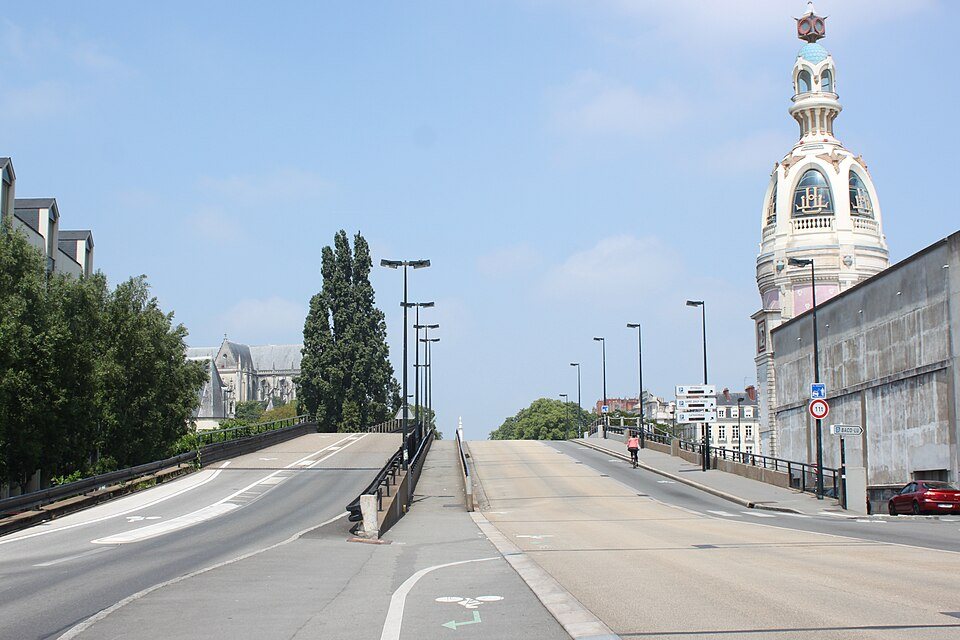
In 1895 Louis Lefèvre-Utile, whose Nantes biscuit company LU was famous for its Petit Beurre, built a new factory on the quai Ferdinand-Favre to develop new products. It was built entirely of concrete and metal, innovative for the time, and in 1909 two corner towers were added by the architect Auguste Bluysen in a style close to Art Nouveau. They were meant to proclaim the company's power, closing the view along the cours Saint-Pierre and Saint-André and answering the towers of the ducal castle.
The bombing of 1943 damaged the towers without destroying them. Both lost their tops in building work in 1972, and the western one was razed altogether in the 1980s to make way for a hotel. Production, and the 450 people who worked here, moved in 1986 to a new plant at La Haie-Fouassière, and most of the factory was demolished, leaving only the annex on the quai Ferdinand-Favre.
Artists in the ruins
From 1989 artists, among them the street-theater company Royal de Luxe, took over the empty building. Jean Blaise, director of a cultural research center that had staged festivals here, persuaded the city to keep the building as a place where the most innovative art would sit in the middle of everyday life. The city bought the annex in 1995; the southern part of the old works was cleared for new offices, including the headquarters of Nantes Métropole, and the northern part was protected. The architect Patrick Bouchain converted it from 1998, deliberately keeping its industrial character, and Jean-Marie Lépinay restored the surviving tower.
The festivals that made the building's name before it was converted were Les Allumées, which ran every year from 1990 to 1994, then Trafics in 1996 and 1997 and Fin de siècle from 1997 to 1999. Their success is what convinced the city that the old factory could be a cultural center rather than a demolition site.
The Lieu Unique opened on the night the century turned, December 31, 1999. It is a national stage, a scène nationale, with shows, concerts, exhibitions and talks, along with a café-bar-club, a restaurant, a reading room and a crèche. Jean Blaise ran it until the end of 2010.
Patrick Gyger directed it from January 2011 to December 2020. The building stands in the Champ-de-Mars district at the eastern tip of what was once the Île Gloriette, and its west front on the busy avenue Carnot is blank, so the way in is always from the canal side.
A time capsule in the wall
For its opening the artist Patrick Raynaud created the Grenier du Siècle, the attic of the century. From October 1 to December 31, 1999, anyone could bring a personal object that represented their life. The 16,000 objects left were catalogued, packed and sealed inside a translucent double wall in the attic of the old factory, and they are to be opened on January 1, 2100. The wall faces the rue de la Biscuiterie on the south side.
The tower
The restored tower is 38 meters high and topped with a lantern identical to the one on the LU pavilion at the 1900 World's Fair, and a metal spire. Its dome has six windows shaped like inverted chains, crowned with carved eagles, and on its body a figure of Fame blows a trumpet among six signs of the zodiac. A staircase of 130 steps leads to the top, with a wide view over the city, and the tower reopened to the public in 2022 after several years of work.
The entrances are on the quai Ferdinand-Favre and the quai Malakoff; the quai Ferdinand-Favre is now pedestrian, a terrace under old plane trees along the Saint-Félix canal. The castle, the cathedral, the conference center and the station are all less than 500 meters away, so it fits easily between other visits, and the terrace on the quai is one of the pleasantest places in the center to sit with a drink. The large hammam that occupied part of the building closed on December 31, 2024.
Sources
Le Lieu Unique in pictures