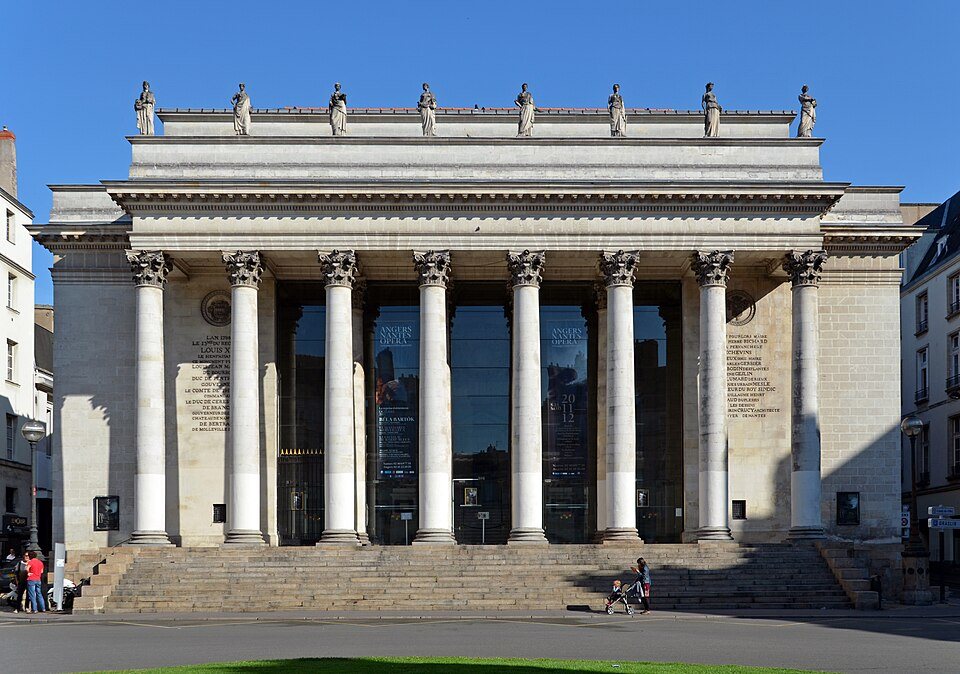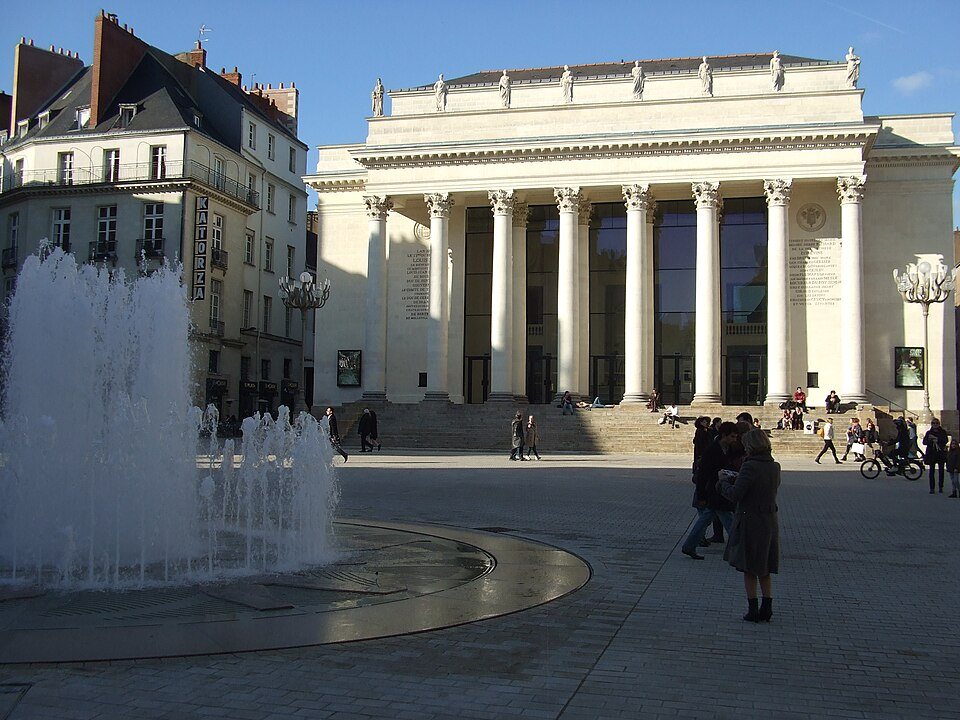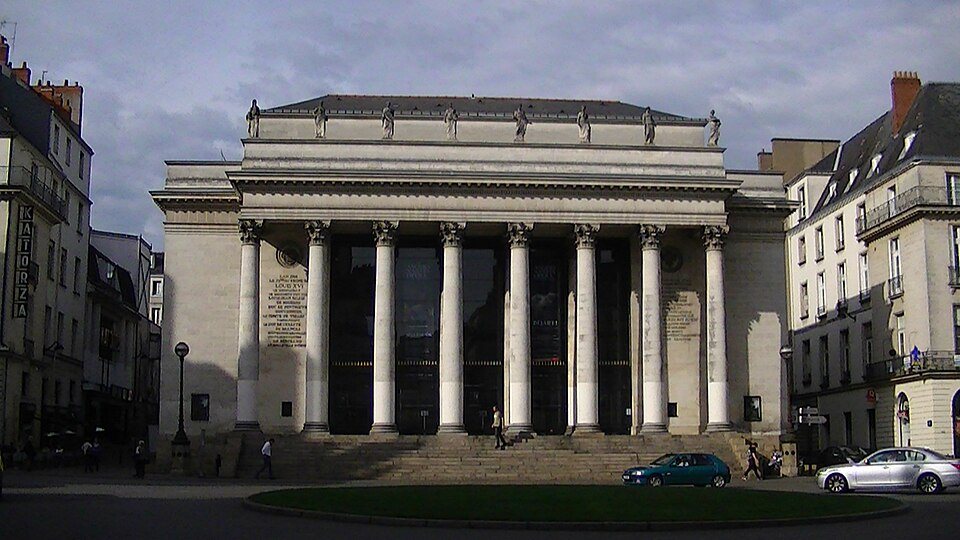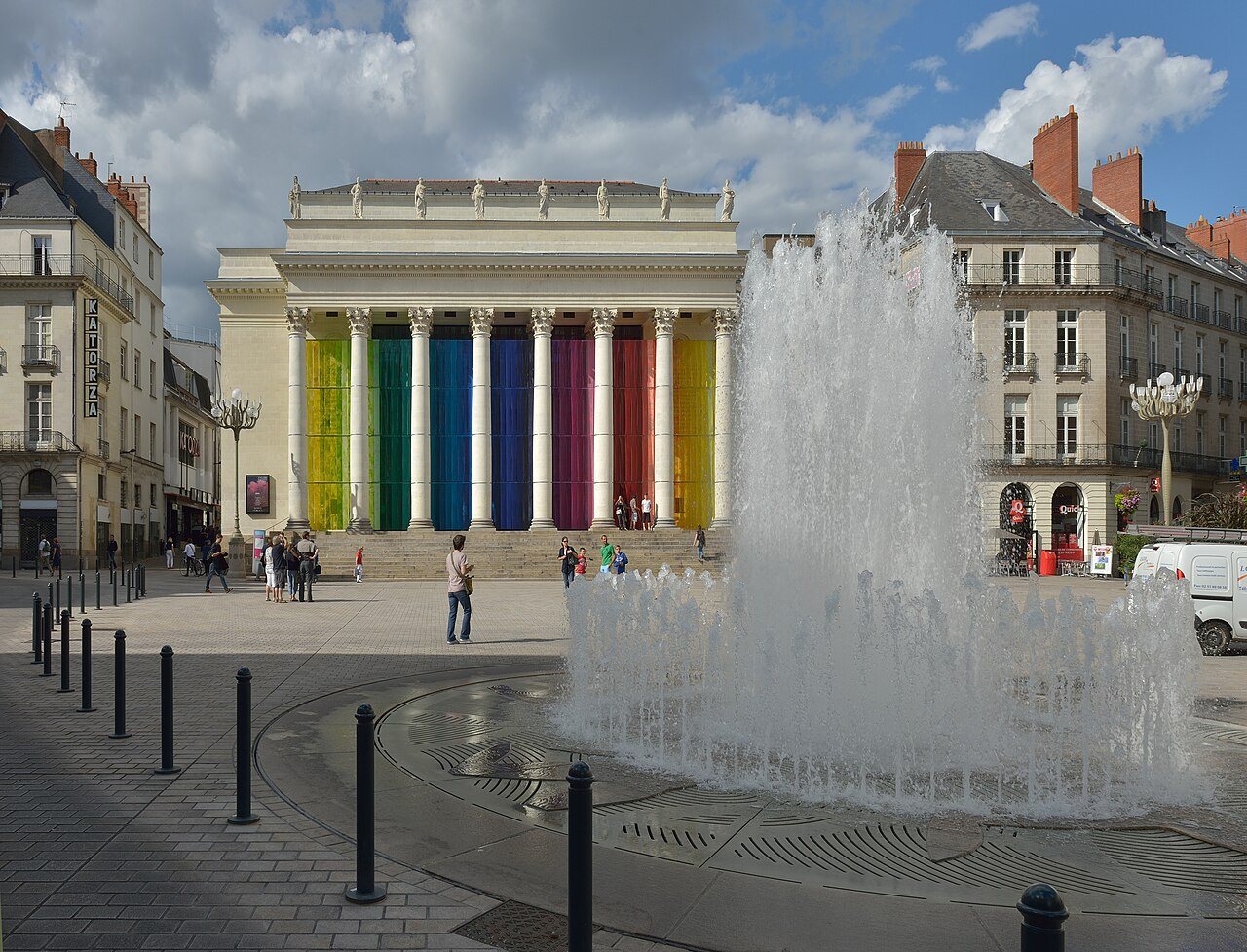
The Théâtre Graslin opened in 1788, burned down in 1796, and was rebuilt. Eight Corinthian columns and eight muses on the roofline face a small sloping square that was laid out as a single architectural composition.
Beside it is La Cigale, a brasserie of 1895 whose interior is a listed riot of ceramic tile, mirror and mosaic — genuinely one of the most decorated rooms in the city.
The streets behind, towards the Rue Crébillon, are where Nantes does its serious shopping.
You can look into La Cigale without eating. It is worth doing even if you are not stopping.
A developer's square
From 1777 Jean-Joseph-Louis Graslin, the receiver general of the royal tax farms, bought up large plots of land on a thinly populated rocky hill west of the city and set out to develop them. The city council was reluctant, so Graslin won it over by giving the land for the streets and squares, paying for the leveling and lending money cheaply. The square, a rectangle joined to a half-circle opening to the south, is fed by eight streets named after writers: Crébillon, Molière, Corneille, Racine, Voltaire, Piron, Regnard and Jean-Jacques Rousseau. It is entirely pedestrian and mostly paved, and it was designed as an enlarged foyer for the theater, where audiences waited before a performance or during the interval.
The second prestigious building Graslin managed to place on the square was the Hôtel Henri-IV, later the Hôtel de France, at number 2. The English traveler Arthur Young wrote in 1787 that he doubted there was a finer inn in Europe. At number 3, opposite the theater, a relief of buoys, anchors and tangled ropes over the door marks the former Nantes headquarters of the Compagnie générale transatlantique, which operated here after the Second World War until 1970.
The theater
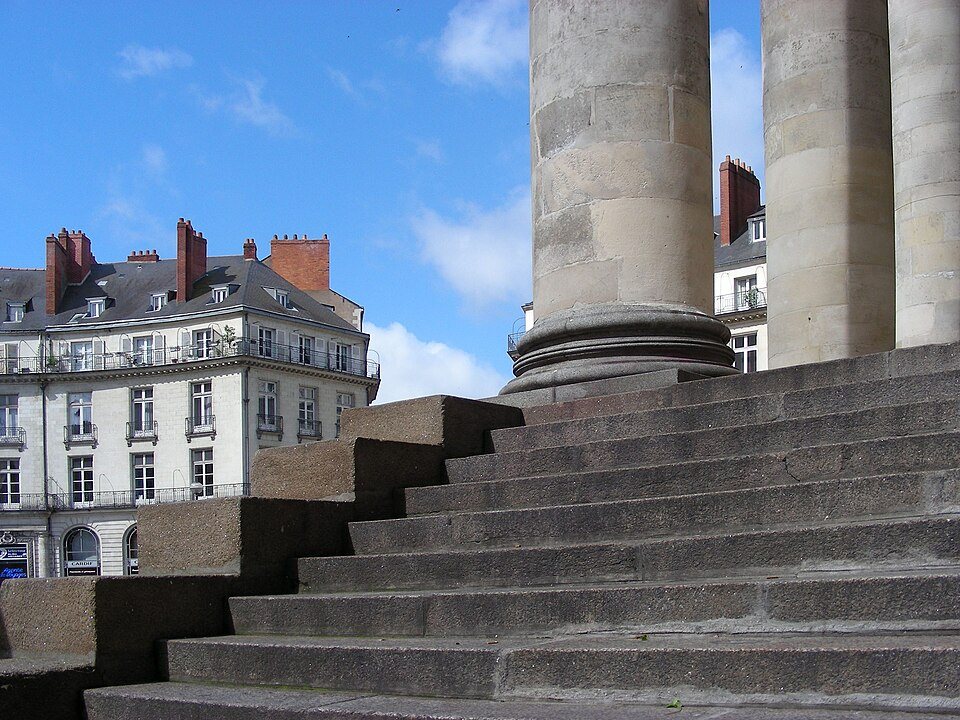
Graslin asked the architect Mathurin Crucy in 1780 to design the playhouse. Thirteen steps lead up to the portico, where eight Corinthian columns carry the pediment. On August 24, 1796, during a performance of Grétry's opera Zémire et Azor, a piece of scenery caught a candle flame; whipped by a strong wind, the fire reached the roof and brought down the dome and the great chandelier, and seven people died. The theater was only rebuilt after Napoleon's visit in 1808, from 1811, again under Crucy.
The eight Muses on the roofline, eight of the nine, are by Dominique Molknecht, who made them from 1818; they were set above the columns in 1825. Stendhal, who stayed in Nantes in 1837 and 1838, was not won over by the result. Today the theater seats 784 and is one of the two homes of Angers Nantes Opéra.
What happened on stage
Liszt gave a concert here on December 17, 1845, and Massenet conducted his own work in 1885. Wagner's Lohengrin, badly received in Paris in 1887, was staged at Graslin on February 22, 1891, and well received. The great actor Talma played Orestes here in 1813, soon after the reopening. Most famously, on February 12, 1918, the Harlem Hellfighters, the band of the American 369th Infantry Regiment led by James Reese Europe, played on the steps and then inside the theater, giving the first jazz concert on the European continent.
La Cigale
Facing the theater, the brasserie La Cigale opened on April 1, 1895. It is the work of the Nantes architect and ceramicist Émile Libaudière, and it has been a listed historic monument since 1964. Both the theater and the square appear in Jacques Demy's Lola and in Agnès Varda's Jacquot de Nantes, her film about Demy's childhood.
An audience that voted
For a long time the audience chose the company. The director rented the theater from the city but did not pick the singers: new recruits had to appear before a packed house and sing three operatic extracts, and the subscribers voted by cheering or booing them, an ordeal for the performers. Composers came to hear their own works, Boieldieu in 1819 and Auber in 1821, and the tenor Gilbert Duprez, famous as the first to sing a high C in full chest voice, had such a triumph in 1849 that the public tried to keep him; he stayed on until the end of the month.
From 1868 Graslin faced a rival, the new Théâtre de la Renaissance, with more than 3,000 seats. The rivalry lasted until 1875, when the city bought the Renaissance and put both under one director, and the Renaissance stood in during repairs at Graslin in the 1879–1880 season before it burned down in 1912. After the defeat of 1940 the board decided not to hold a season, but the occupying authorities wanted the theater open, and it reopened in January 1941 to large audiences.
Sources
Place Graslin & the Théâtre in pictures