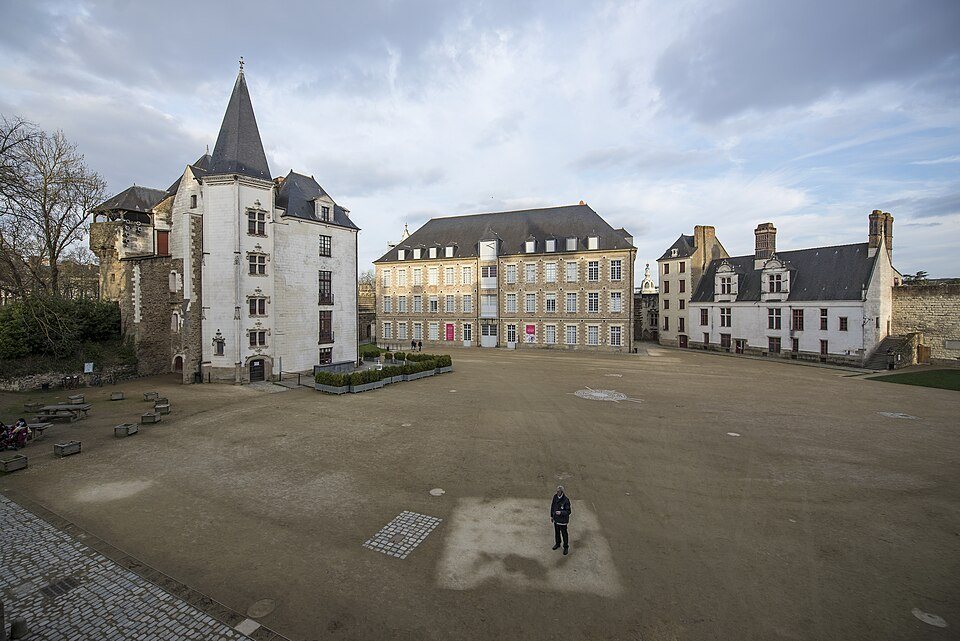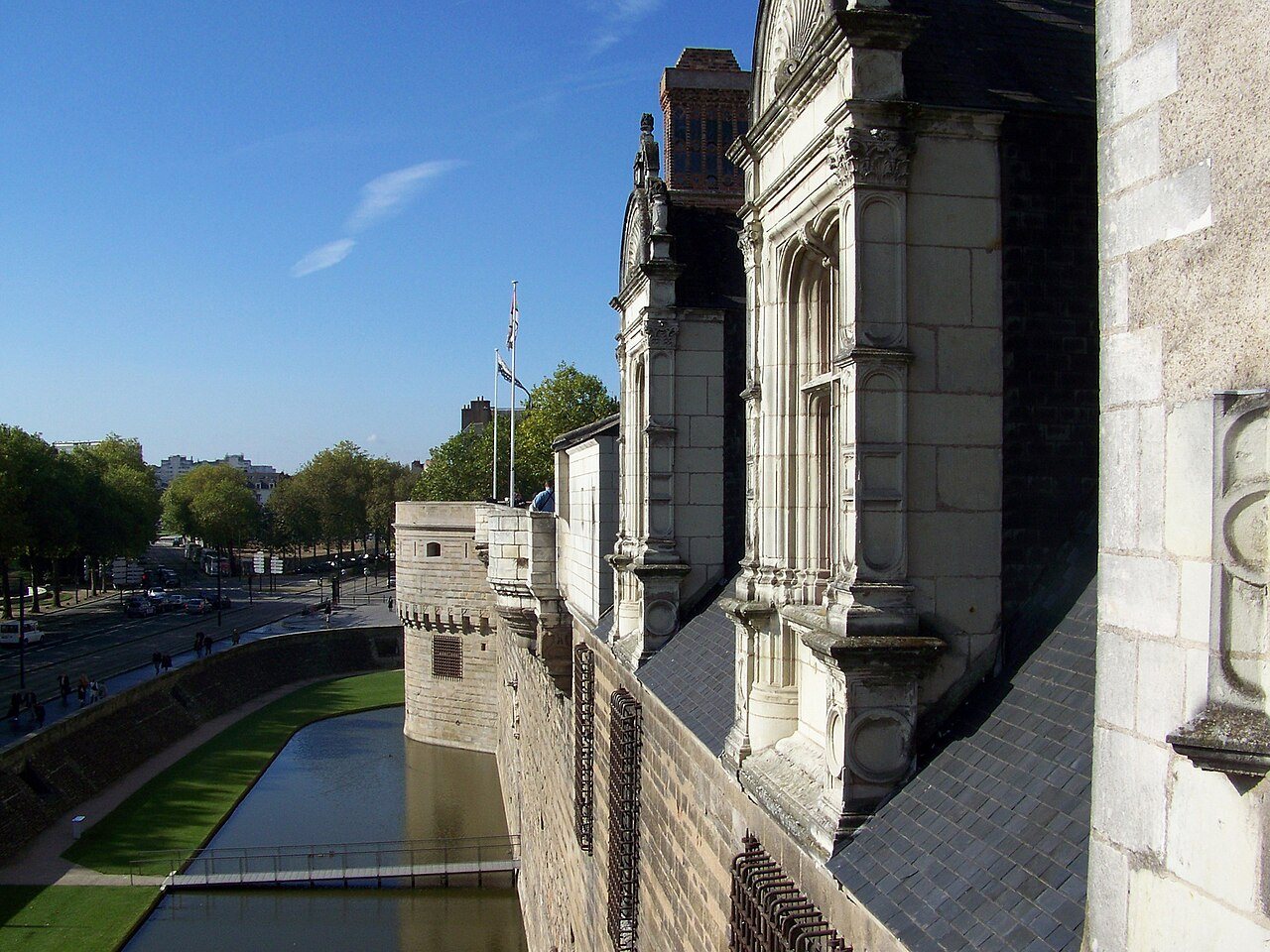
From the moat it is a defensive ring of granite towers and curtain wall. Step through the gate and the inside is an entirely different building: a late-Gothic palace in pale tuffeau limestone, with carved dormers and a loggia, built for living rather than for holding out.
The dukes of Brittany ran an effectively independent state from here until the duchy was absorbed into France; Anne of Brittany, twice queen of France, was born into this line and the building is where Brittany's separateness is most legible.
You can walk the ramparts and cross the courtyard without a ticket, which makes it one of the best free half-hours in the city. The museum inside — thirty-two rooms on the history of Nantes including the slave trade — is the ticketed part.
Walk the rampart walk at the end of the day. It is free, it circles the whole castle, and it is the clearest view you will get of how the old town is laid out.
A castle rebuilt by a duke
There was a castle here long before the one you see. Between 1207 and 1248 the Château de la Tour Neuve was built in the south-east corner of the Gallo-Roman walls, below the cathedral, named after its great round keep of gray schist, which has since vanished. Dukes of the thirteenth century enlarged it, and after the Breton war of succession ended in 1365 Jean IV de Montfort strengthened it again.
In 1466 Duke François II wrote that his castle at Nantes was falling into decay, and he decided to rebuild it entirely, calling on the best architects in the duchy, among them Mathurin Rodier, who was also rebuilding the cathedral. The whole fortification seems to have been in place by 1486. Of the old Tour Neuve only one tower survives, the so-called Vieux Donjon on the north wall, its irregular plan and granite blocks quite different from the rest.
Anne of Brittany
François II died without a son, and the ducal crown passed to his daughter Anne. Her proxy marriage to Maximilian of Austria in 1490 provoked Charles VIII of France; in 1491 the castle's governor, Alain d'Albret, betrayed her and handed it to the king, and after the fall of Rennes Anne was forced to marry Charles. Her second royal marriage, to Louis XII, gave her more freedom, and she came back to Nantes several times, adding loggias and finishing her father's work so the castle could house a queen's court. After her death in 1514 the duchy passed through her daughter Claude to the French crown, and from 1532 the castle was the royal residence in Brittany.
Reading the courtyard
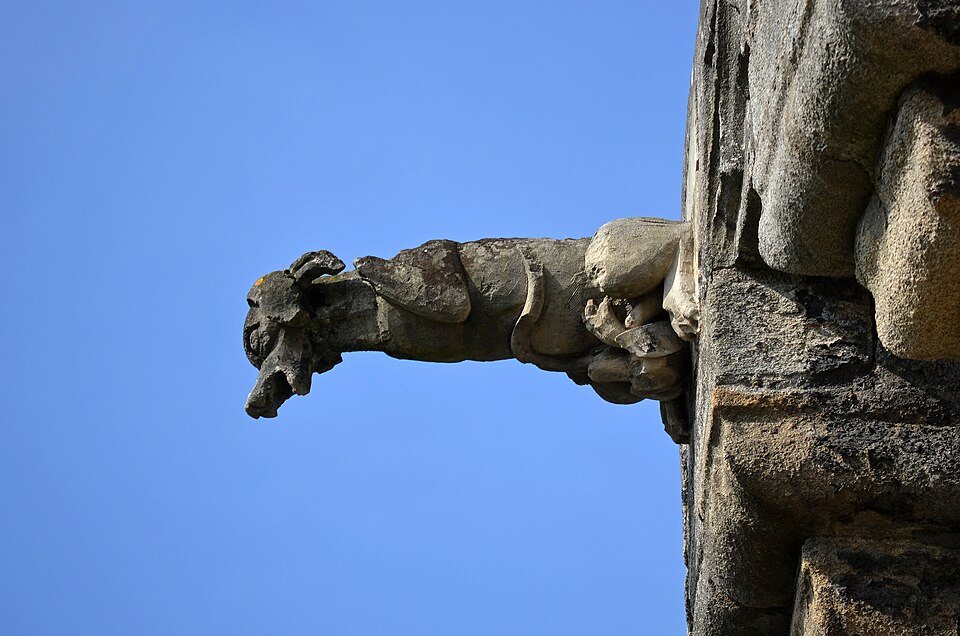
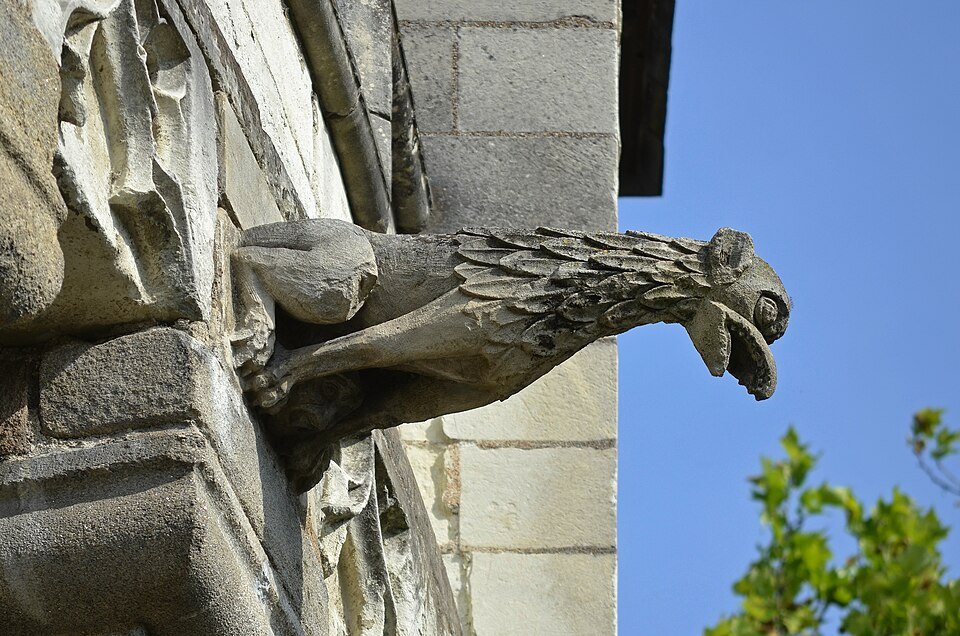
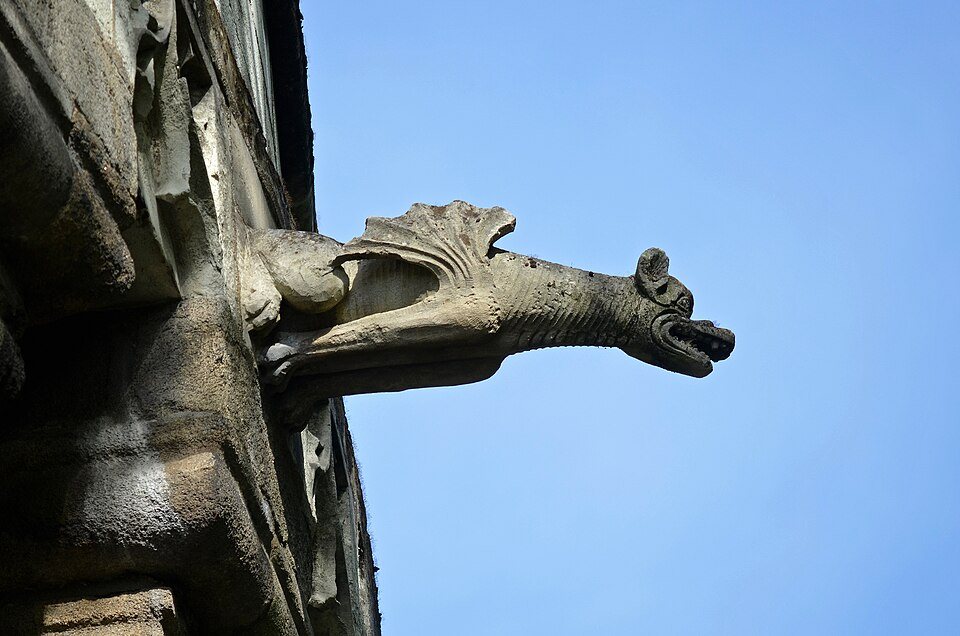
The largest buildings are the Grand Logis and the Grand Gouvernement, both built by François II against the curtain wall. The Grand Logis is the most imposing, plainly Gothic, with carved grotesques; the Grand Gouvernement, finished in the early 1480s, was the duke's own lodging. Between them the Tour de la Couronne d'Or holds two spiral stairs and, on its upper floors, two loggias. At its foot is a fifteenth-century well with a granite curb and an iron frame carrying seven pulleys, each corner carved with an animal or hybrid beast in the tradition of gargoyles.
The plain rectangular building at the back of the courtyard is the Harnachement, built in 1784 in a purely practical style when France feared an English counterattack during the American War of Independence.
The walls from outside
The curtain walls alternate courses of schist and granite, which both strengthens them and gives the striped look, and their Breton machicolations are purely decorative, with no openings to drop anything through. The corner towers are massive: the Tour de la Rivière, the least altered, and the Tour du Port are each about fifteen meters high, and the horseshoe-shaped Tour du Fer-à-Cheval at the north-east corner is 30 meters long and 18 meters high. The Tour du Port was swallowed by a sixteenth-century bastion and only rediscovered in 1854, when the bastion was demolished. Until the 1930s an arm of the Loire ran along the south side, feeding the moat; it was filled in from 1938 to 1940 and is now the cours John-Kennedy.
The explosion of 1800 and the museum
On May 25, 1800, a rotten ceiling in the Tour des Espagnols collapsed onto the gunpowder stored there. The explosion destroyed the tower completely, and only its foundations remain, visible in the moat; it also tore away a large part of the Grand Gouvernement. The army held the castle until the First World War, and the city took possession of it in 1915. A museum opened in 1924, and after a long restoration campaign that began in 1989 the castle reopened as the museum of the history of Nantes, its 32 rooms showing more than 1,150 objects. In 2017 it drew 230,000 visitors, more than any other museum in the city.
Sources
Château des Ducs de Bretagne in pictures