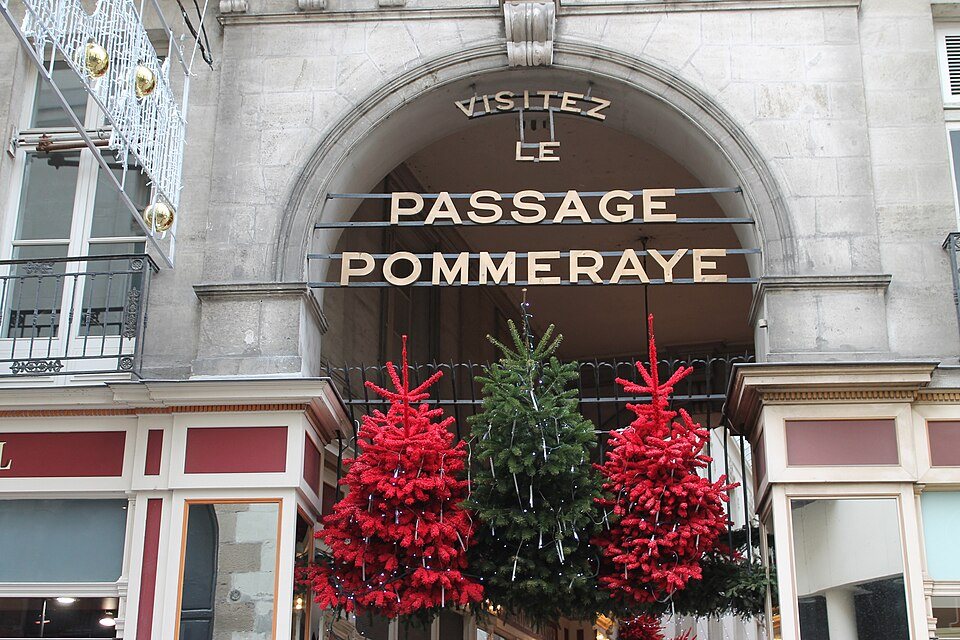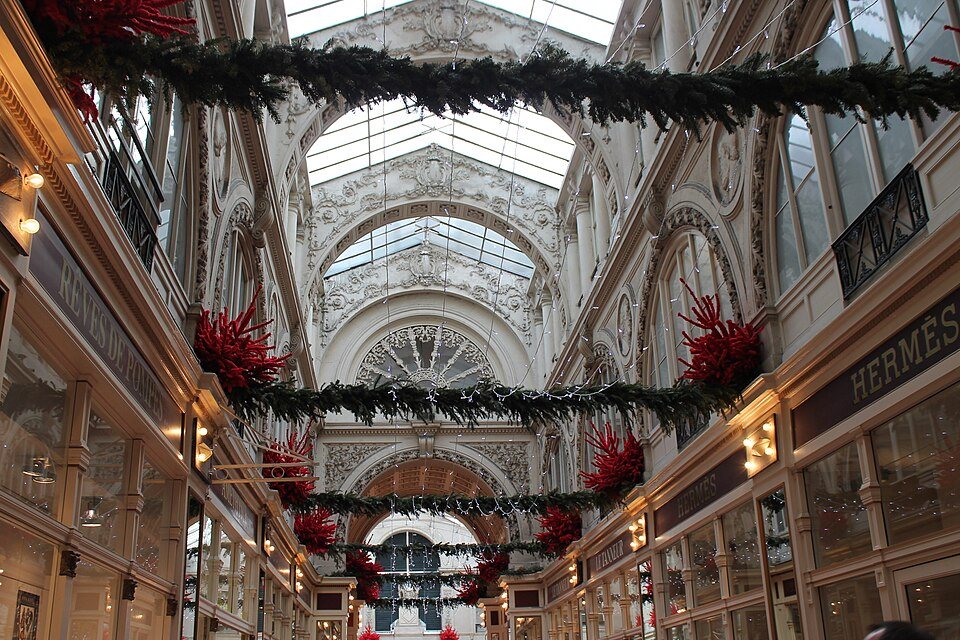
It opened in 1843, and its trick is the slope: the ground drops so steeply between the two streets it connects that the arcade had to be built as three stories stacked down the hill, linked by a monumental staircase under a glass roof.
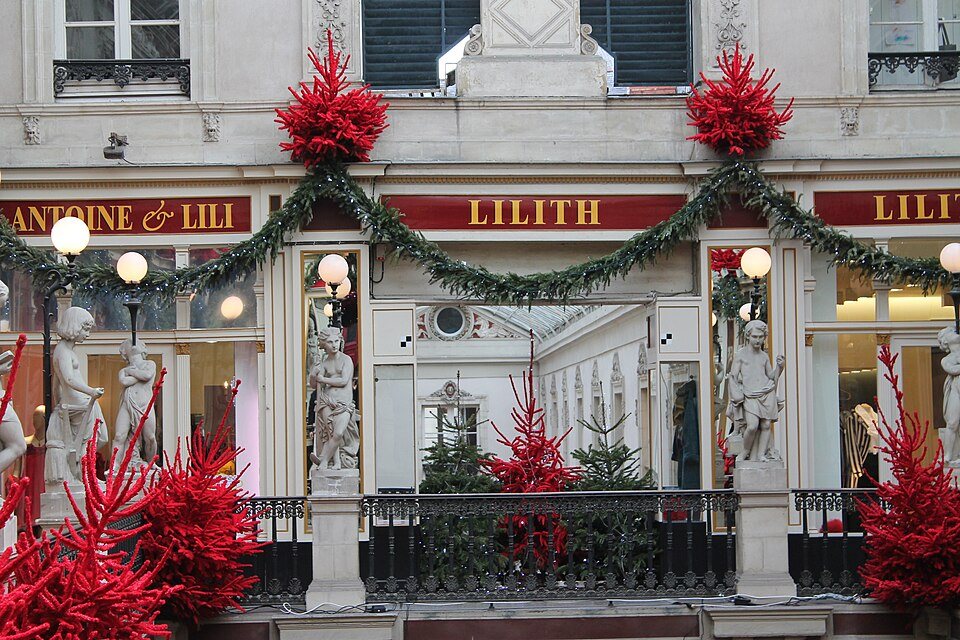
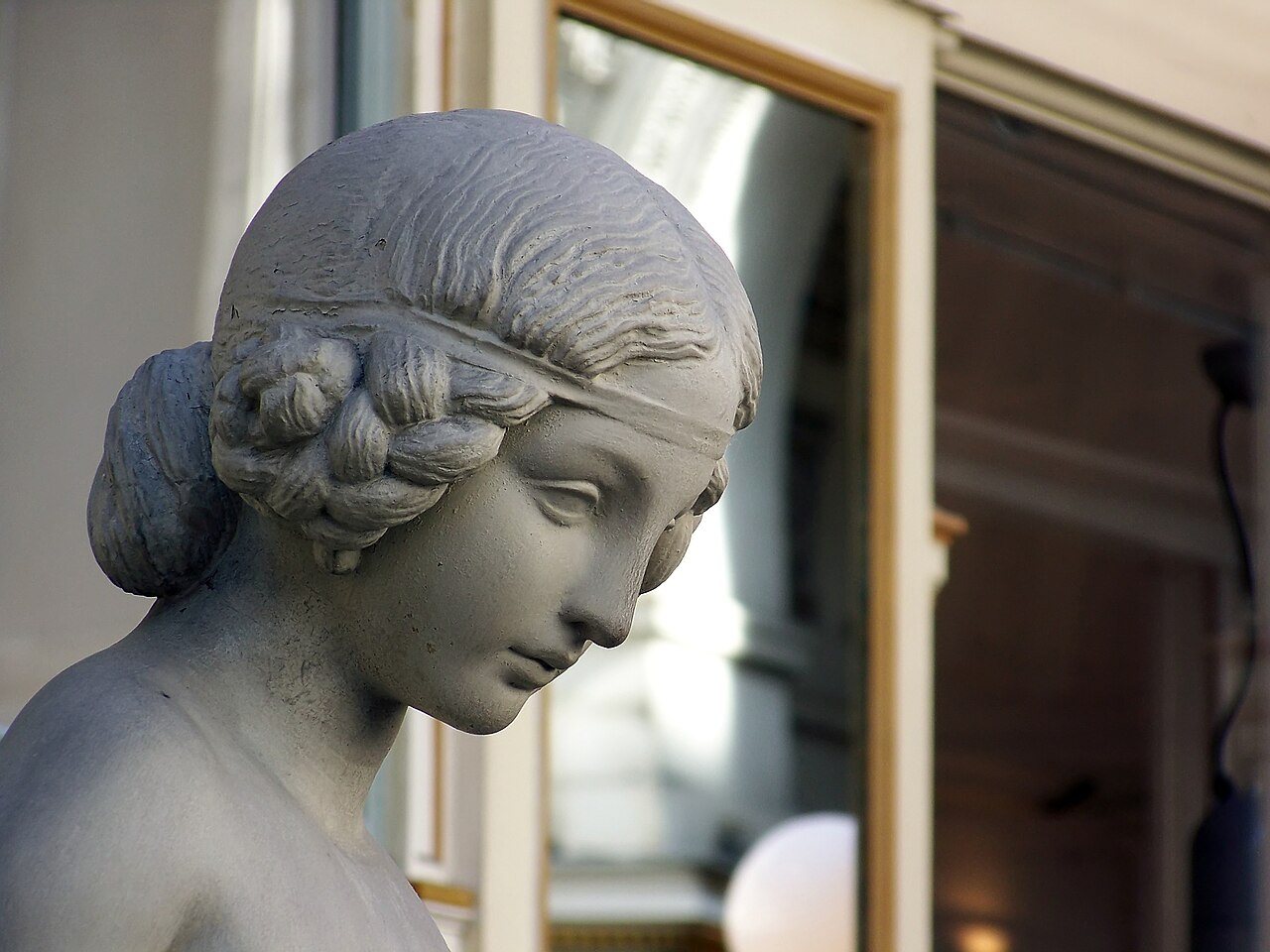
The galleries are lined with statues — allegorical figures of commerce, industry, the arts and the sciences — looking down over the balustrades at the shoppers. It is one of the most complete nineteenth-century arcades left in France and it is still an ordinary working shopping street.
It has appeared in a good deal of French cinema, most famously in Jacques Demy's Nantes films.
Enter from the lower end on Rue de la Fosse and climb. Coming down the stairs is fine; coming up them is the view the building was designed around.
A notary's gamble
Paris had its covered arcades from the end of the eighteenth century, but the first in Nantes, the small passage d'Orléans, dates only from 1827. Arcades were a real comfort when many streets had no sidewalks and turned to mud in the rain. The idea for this one came from the architect Jean-Baptiste Buron, working for the restaurateur Charles Guilloux, who joined forces with an ambitious young notary, Louis Pommeraye.
Work began at the end of 1840 amid a year of complaints, petitions and lawsuits from evicted tenants and neighbors, and the arcade opened on July 3, 1843. Its other novelty was gas lighting, tricky to regulate across such a slope. It was an immediate success with the people of Nantes, but the economic crisis of 1848 sank the company, which was wound up in 1849. Pommeraye, who had put in everything he owned and mortgaged his wife's inheritance, was ruined, and died in hiding in 1850. His main creditor, Baron Henri Baillardel de Lareinty, bought the arcade in 1851 and in 1852 opened the side gallery to the rue du Puits-d'Argent, which gave the passage its Y shape.
Three levels on ten meters of slope
The drop between the rue de la Fosse and the rue Santeuil is about ten meters. The architects Jean-Baptiste Buron and Hippolyte Durand-Gasselin turned that problem into the design: three levels, the Galerie de la Fosse at the bottom, the Galerie Régnier as a mezzanine and the Galerie Santeuil at the top, joined by the great central staircase with a broad landing halfway. Their three-level arcade is described as unique in Europe. Iron and glass roofs light the galleries between buildings up to four stories high, and the stair, railings and gas lamps were cast by the Voruz foundry of Nantes.
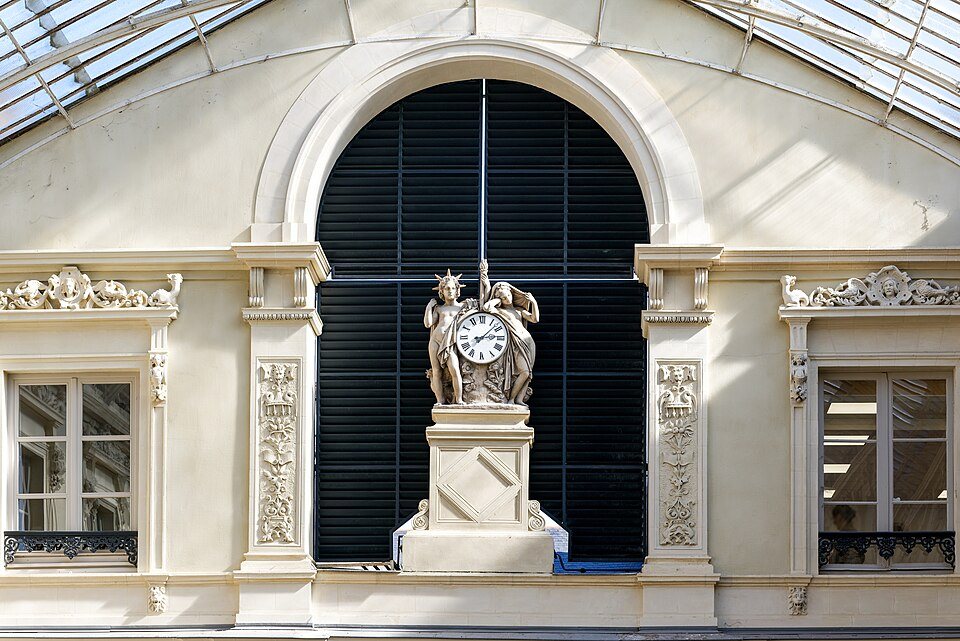
Who is on the walls
The Parisian sculptor Jean Debay made the terracotta allegories on the second and third levels around the staircase, representing Commerce, Industry, Agriculture, the Fine Arts, Spectacle, the Sciences and Maritime Commerce, each in several copies. He also made the two children framing the clock, Day and Night, and bronze busts of Jean-Baptiste Ceineray and Mathurin Crucy, the two architects who transformed Nantes between the 1760s and 1820s. Between the windows of the Galerie Santeuil, Guillaume Grootaërs carved eight medallions thought to show famous people of the region, among them Abélard and Olivier de Clisson. On the floor, a band of dark tiles traces an imaginary sidewalk along the shop fronts.
Restored, and on screen
The arcade has been a listed historic monument since 1976. Between January 2013 and March 2015 it was restored to its 1843 appearance rather than repaired as it was; the original lamp designs were found and reproduced with LED lights inside. A new annex, the Passage Cœur-de-Nantes, opened next door on March 31, 2016.
Jacques Demy, who grew up in Nantes, ran his teenage film club here and, according to Agnès Varda, swapped his Meccano set for his first small camera in one of its shops. The passage appears in his films Lola, The Umbrellas of Cherbourg and Une chambre en ville. Gustave Flaubert came in 1847, when it was brand new, and wrote of rummaging here among Chinese blinds, Turkish sandals and baskets from the Nile.
Shops with a history
Some shops became institutions. At the top of the stairs on the west side, Hidalgo de Paris began as a dentist famous for loud advertising slogans. The Beaufreton bookshop next door spread over six levels and was where young people in Nantes bought their schoolbooks until it closed in 1998. The Moyon-Avenard gallery, run by one family since 1885, turned into an art gallery showing painters from Nantes and, from 1957, Bernard Buffet.
The photographers Jules Sebire and Fouquet were the first of their trade to set up in the arcade, and Charles Sexer, who followed them in 1859, became well known. In 2013, before the restoration, about 34,000 people a week walked through.
Sources
Passage Pommeraye in pictures