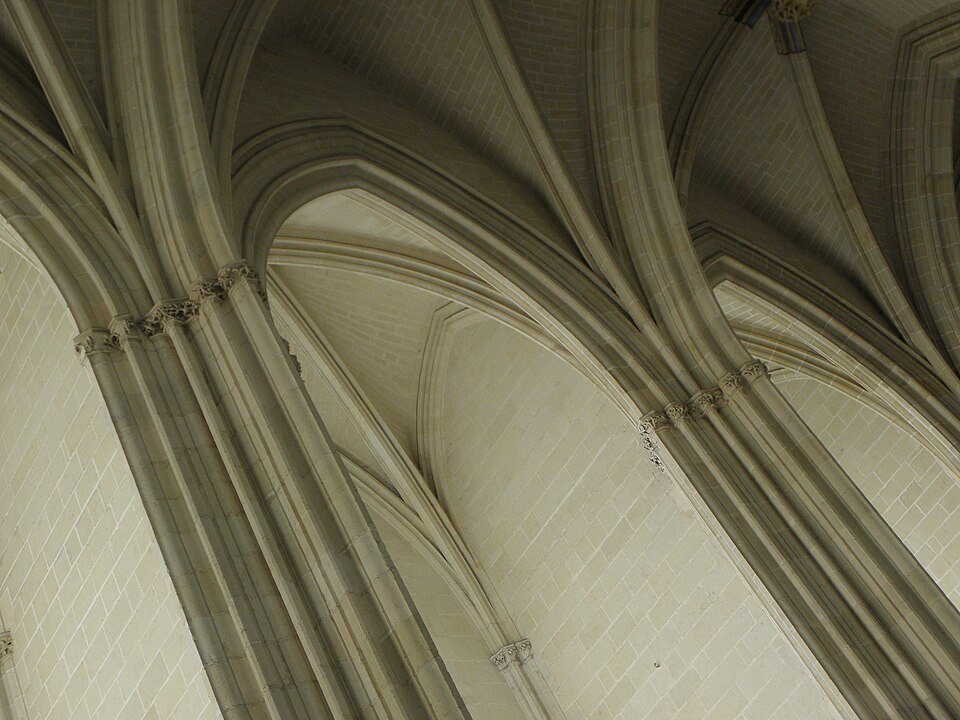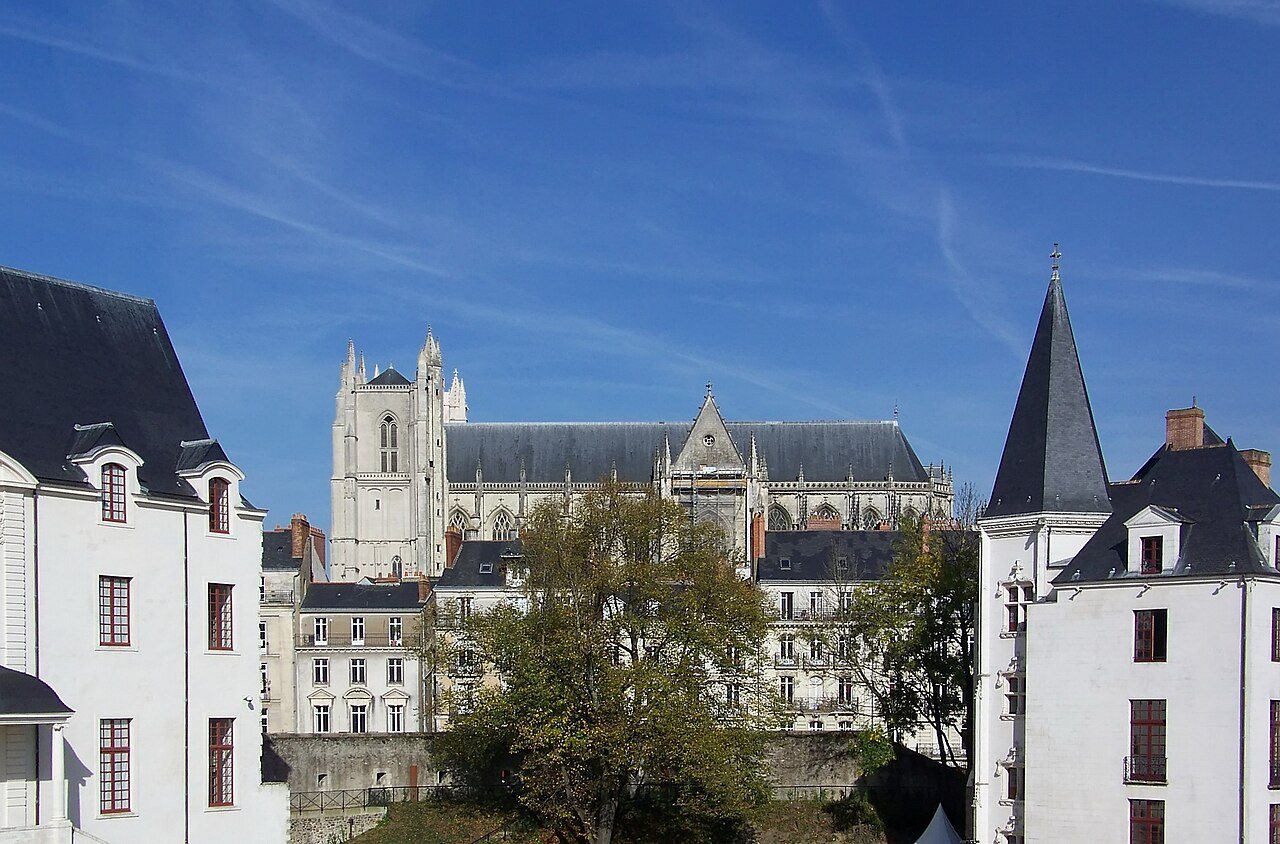
Begun in 1434 and not finished until 1891, which is why the inside is a single soaring space with no stylistic argument in it — the builders held the line for four centuries. The nave is higher than Notre-Dame de Paris and it is faced throughout in white tuffeau, which is why it is so startlingly bright inside.
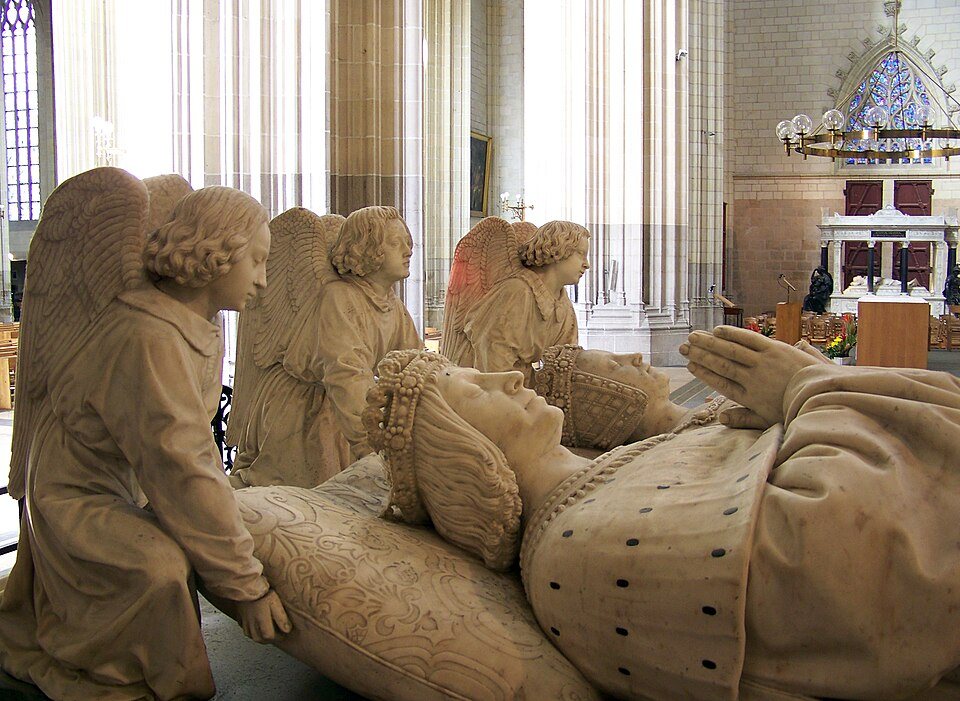
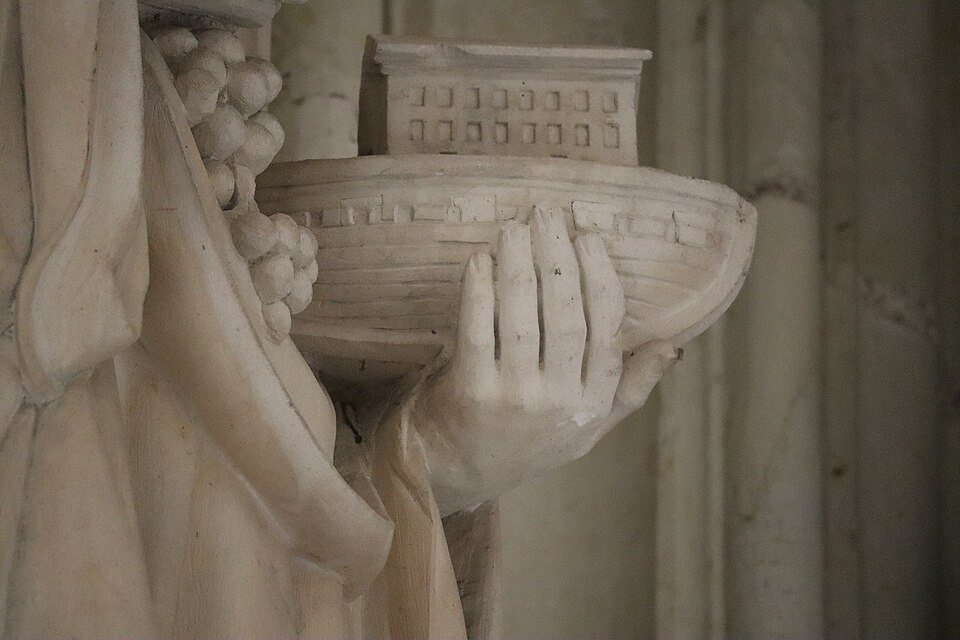
The tomb of François II, the last duke of Brittany, and his wife is the great object here — a Renaissance monument with four figures at the corners representing the virtues, carved with extraordinary delicacy.
It has had a hard time. A fire in 1972 destroyed the roof, and another in 2020 destroyed the great organ. Restoration is long-running, and parts of the building may be closed.
Free, bright, and rarely busy. It is two minutes from the château, so the two go together.
Three churches before this one
Christian worship on this hill goes back a long way. A basilica stood here in the fourth century, a first cathedral was built in the sixth, consecrated by Bishop Félix, and a Romanesque cathedral followed after 1130. The present building rose on the site of that last one, swallowing it bit by bit. Tradition credits the city's first bishop, Saint Clair, with bringing a nail from the cross of Saint Peter, which is why the cathedral is dedicated to Peter and Paul.
Duke Jean V and Bishop Jean de Malestroit laid the first stone of the Gothic cathedral on April 14, 1434. The work was led first by Guillaume de Dammartin and then by Mathurin Rodier, the same master builder who worked on the ducal castle. Only when the town walls to the east were pulled down could the cathedral be finished: the north transept and the east end were begun in 1840, the old Romanesque choir came down from 1876, and the building was finally inaugurated on December 25, 1891.
Higher than Notre-Dame
The vault of the nave rises 37.5 meters, against 33 at Notre-Dame de Paris, though the whole building is shorter, 103 meters inside against 130. The west front is framed by two massive towers with flat tops, and it has two unusual features: an outdoor pulpit for preaching to crowds gathered in the square, and five portals with richly carved arches.
The duke's tomb
The tomb of Duke François II and his wife Marguerite de Foix, the parents of Anne of Brittany, was carved in marble by Michel Colombe over five years, from 1502 to 1507, to designs by Jean Perréal. It is counted among the masterpieces of French sculpture, a hinge between the Middle Ages and the Renaissance in which Italian and French styles meet. The twelve apostles decorate its sides, and at its corners stand four women, the cardinal virtues.
Fires and bombs
During the Revolution the cathedral served as a military lookout during the siege of Nantes in 1793, with a ten-meter wooden tower built on the south tower, then as an arsenal and a stable. It was badly damaged in the bombing of June 15, 1944. On January 28, 1972, a roofer's blowtorch set the roof alight, and most of the timber frame was destroyed; it was replaced with concrete, the choir reopened in 1975, and the restoration of the choir was only finally completed in 2013.
On July 18, 2020, an arson attack destroyed the great organ, whose oldest parts dated from 1619, along with the great west window, set in 1498 and showing Anne of Brittany and her mother, and a painting by Hippolyte Flandrin. The tomb of François II narrowly escaped.
Glass, crypt and bells
The windows of the choir, some 500 square meters of abstract glass designed by Jean Le Moal and made with Anne Le Chevallier between 1978 and 1988, fill the white interior with color. Beneath the building are two crypts, the older of them a Romanesque crypt of the eleventh century from the second cathedral. The south tower holds eight bells, and the choir organ, finished by Louis Debierre in 1897, is described as the largest accompanying organ in France.
History happened outside too. It was in the Place Saint-Pierre, in front of the cathedral, that d'Artagnan arrested Nicolas Fouquet, the king's superintendent of finances, on September 5, 1661, on the orders of Louis XIV.
On the night of November 10 to 11, 1940, early in the German occupation, a young art student, Michel Dabat, and his friend Christian de Mondragon climbed one of the towers and hung a French flag from the top. Dabat was denounced, arrested and sentenced to four months in prison; on October 22, 1941, aged twenty, he was shot with fifteen others at the Bêle firing range, in the reprisals that followed the killing of the German officer Karl Hotz.
Sources
Cathédrale Saint-Pierre-et-Saint-Paul in pictures