The shipyards on the Île de Nantes closed in 1987 and took the city's industrial identity with them. What replaced it is a workshop that builds enormous articulated animals out of wood, steel and hydraulics — and runs them in public.
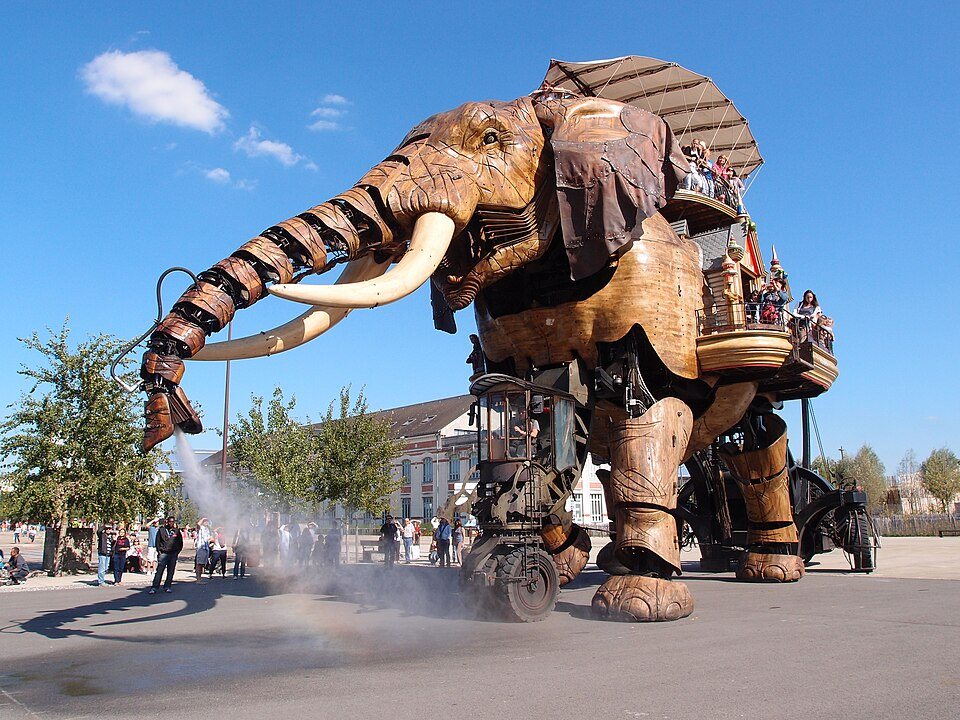
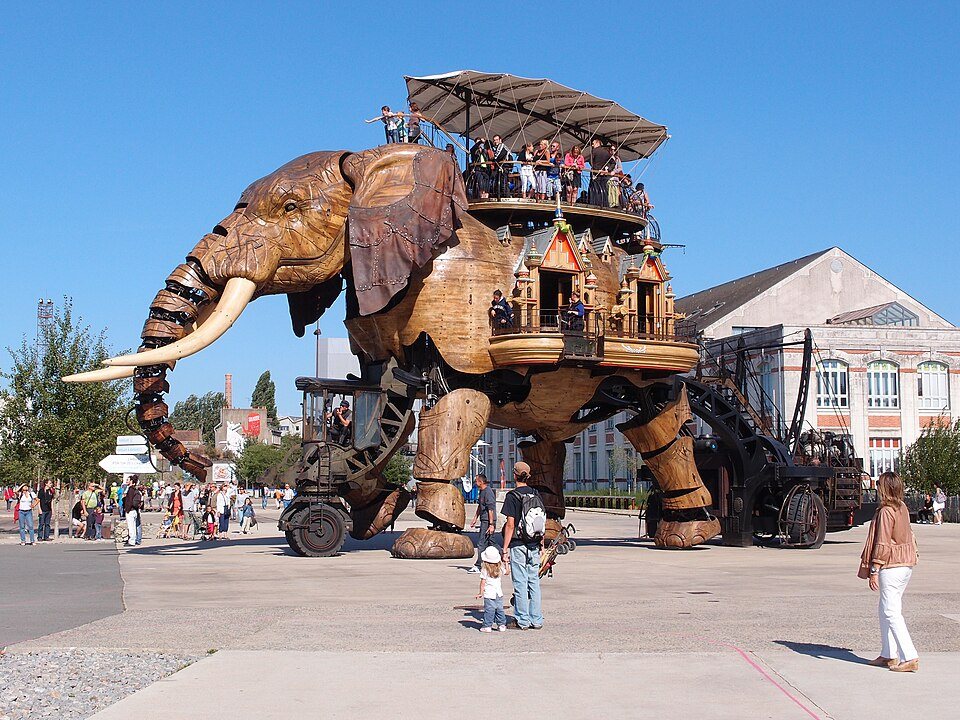
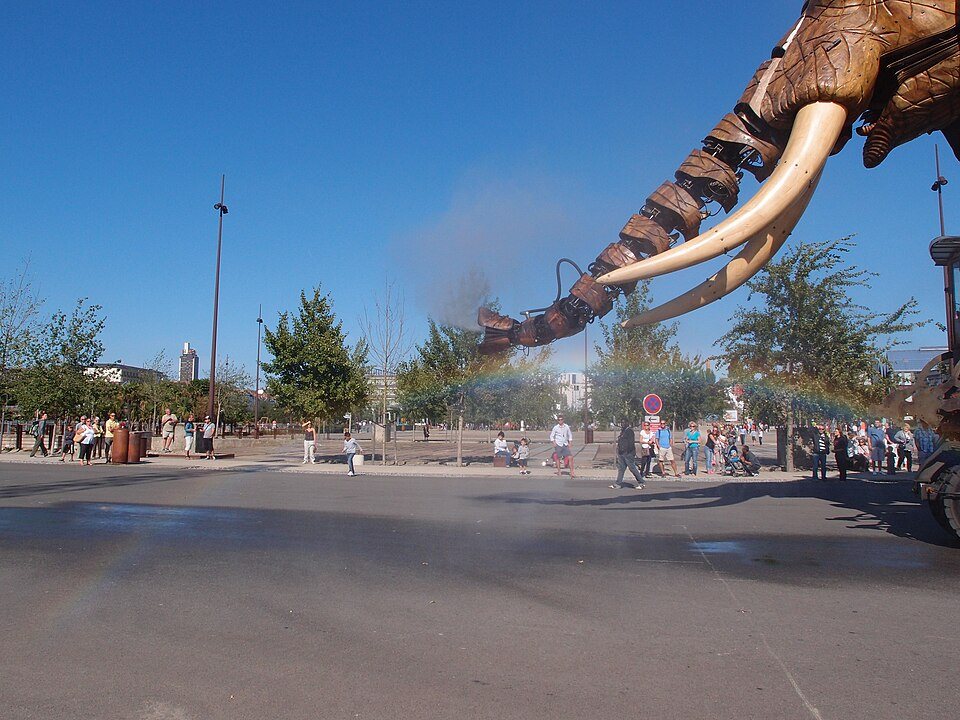
The Grand Éléphant is the one everybody comes for: about twelve meters tall, carrying roughly fifty passengers, walking a slow circuit and spraying water from its trunk. The Carrousel des Mondes Marins is a three-story merry-go-round of deep-sea creatures you operate yourself. The Galerie des Machines is the workshop, where the machinists demonstrate prototypes and you watch the next one being built.
These are separate tickets, and the elephant runs to a schedule rather than continuously. The ride sells out first in school holidays.
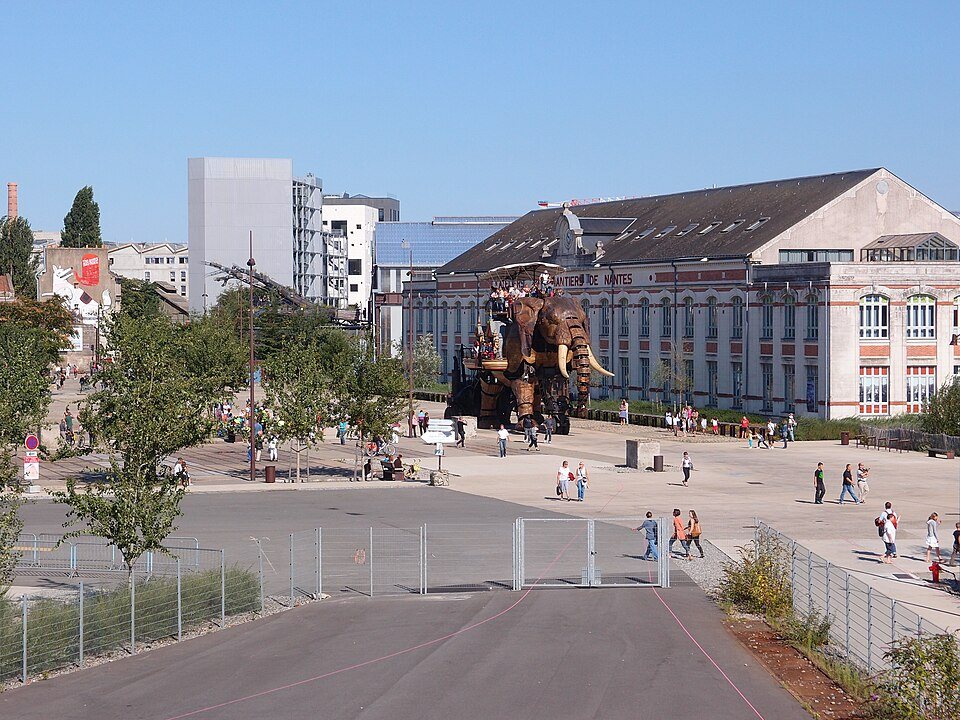
Even with no ticket at all, the elephant walks outdoors on a public quay. You can stand and watch it for nothing — which a surprising number of visitors do not realize.
Who made it
The Machines are the work of François Delarozière, artistic director of the company La Machine and builder of some of the street-theater machines of Royal de Luxe, and Pierre Orefice. As part of the regeneration of the Île de Nantes, the urban community of Nantes Métropole adopted their idea in June 2004, and the site opened on June 30, 2007, in the former Dubigeon shipyard halls in the Parc des Chantiers. It sits, in its makers' words, at the crossroads of the invented worlds of Jules Verne, the mechanical universe of Leonardo da Vinci and the industrial history of Nantes. It is run by the public company Le Voyage à Nantes.
At the start there were four pieces: the Grand Éléphant, a prototype branch of the planned heron tree, the Carrousel des Mondes Marins, which was still to be built, and a children's merry-go-round called the Manège d'Andréa. The idea was always that the bestiary would keep growing as the workshop finished new creatures, and it has: the gallery today holds far more machines than the site opened with.
In its first year it drew 288,000 visitors; by 2016 the figure was 665,000. Within months of opening it won the special jury prize at the international tourism fair in Paris, and it has since received a Thea Award from the Themed Entertainment Association.
The elephant up close
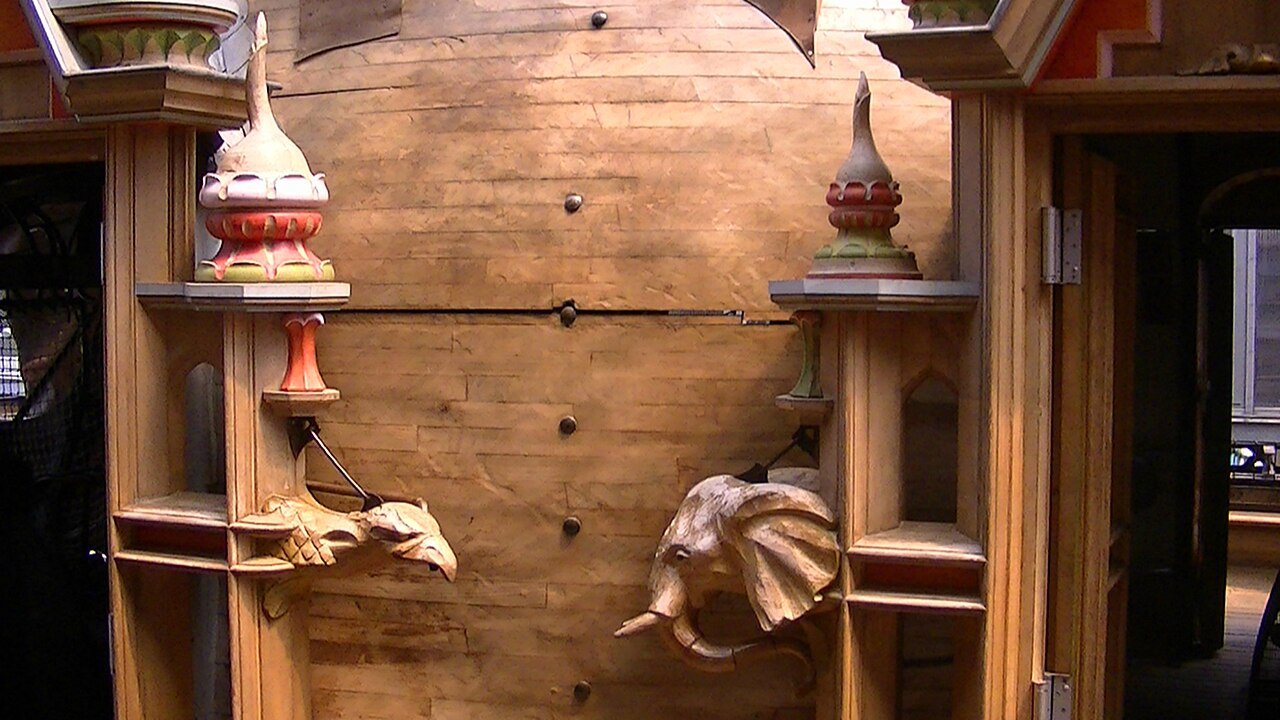
The Grand Éléphant is built of carved tulipwood and steel and weighs 48.4 tonnes. It stands 12 meters high and 8 meters wide and carries 52 passengers per trip on a deck, from which you can see the machinery working and feel every vibration as it walks. From its back the view runs from Trentemoult to the Place du Commerce. Since 2012 passengers have boarded and left by a platform on the Carrousel des Mondes Marins.
The carousel and the gallery
The Carrousel des Mondes Marins opened on July 15, 2012, after several delays. It is a merry-go-round 25 meters high with 36 moving sea creatures on three levels, the seabed, the abyss, and the sea surface with its boats, and it holds 300 people, 89 of them riding the machines. The creatures built since the site opened are shown in the Galerie des Machines and the workshop.
The Galerie des Machines tells the whole story from sketch to working machine. The machinists invite visitors to take the controls of the deep-sea animals, and the gallery comes alive in short shows of five to ten minutes. Its largest creature, the Serpent des Mers, half dragon and half serpent with pearly scales, breathes and spits and carries nine passengers. Later additions include a prototype heron at the scale of the gallery, a caterpillar and a giant ant.
Watching the builders
In one of the halls is the Atelier, the workshop of La Machine, where on more than 3,000 square meters engineers, technicians, boilermakers, welders, sculptors and carpenters shape wood and steel. From two terraces 7.5 meters up, visitors can look down on the makers at work, which is the best way to understand how the animals are built.
The tree that was never built
The great unrealized project was the Arbre aux Hérons, a steel tree 50 meters across and 35 meters high, topped by two herons, with hanging gardens along its branches and rides under the herons' wings. A full-size heron prototype was built from the summer of 2021, and a crowdfunding appeal in 2018 raised money from 5,511 contributors, but the project met opposition and Nantes Métropole finally abandoned it on September 14, 2023. The plan at the time was to install the heron at the Machines.
The Machines are on tram line 1 at the Chantiers Navals stop, and on Busway line 5 at Prairie au Duc.
Sources
Les Machines de l'Île in pictures