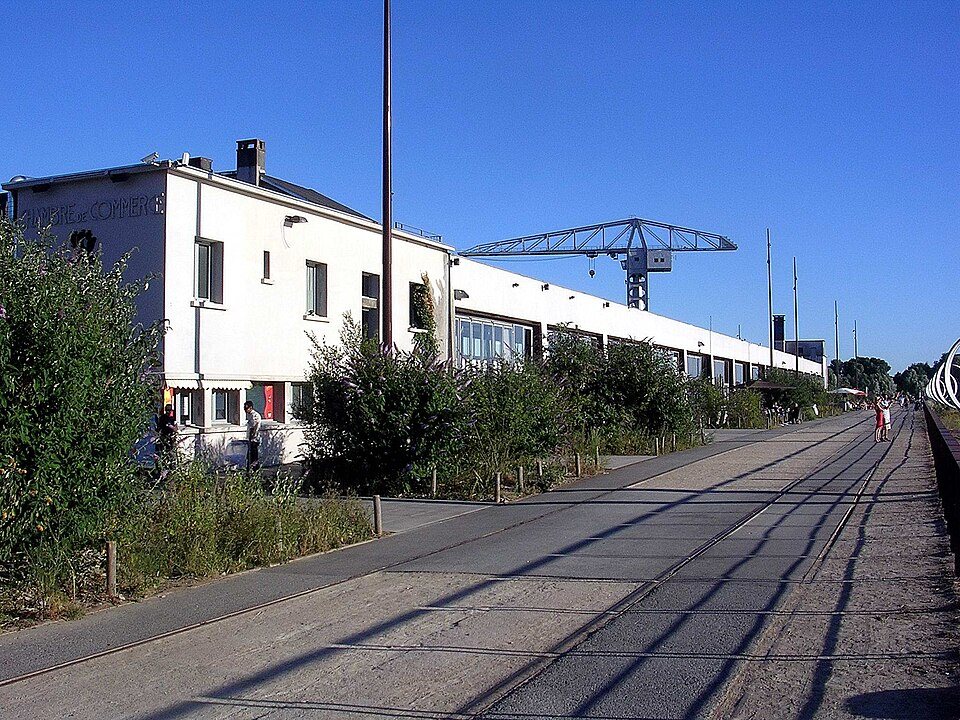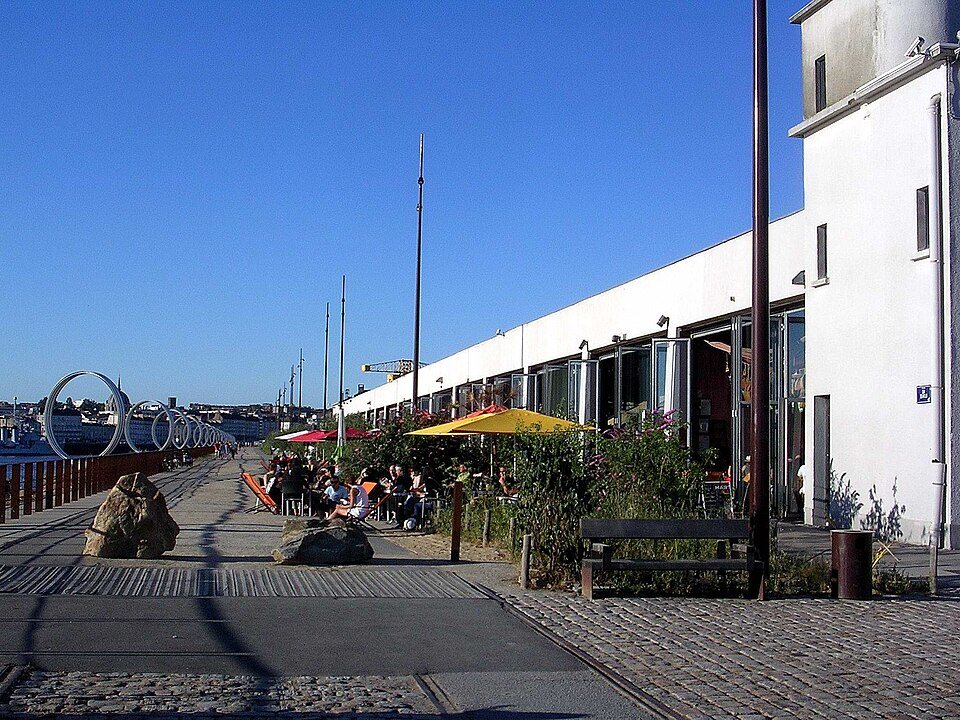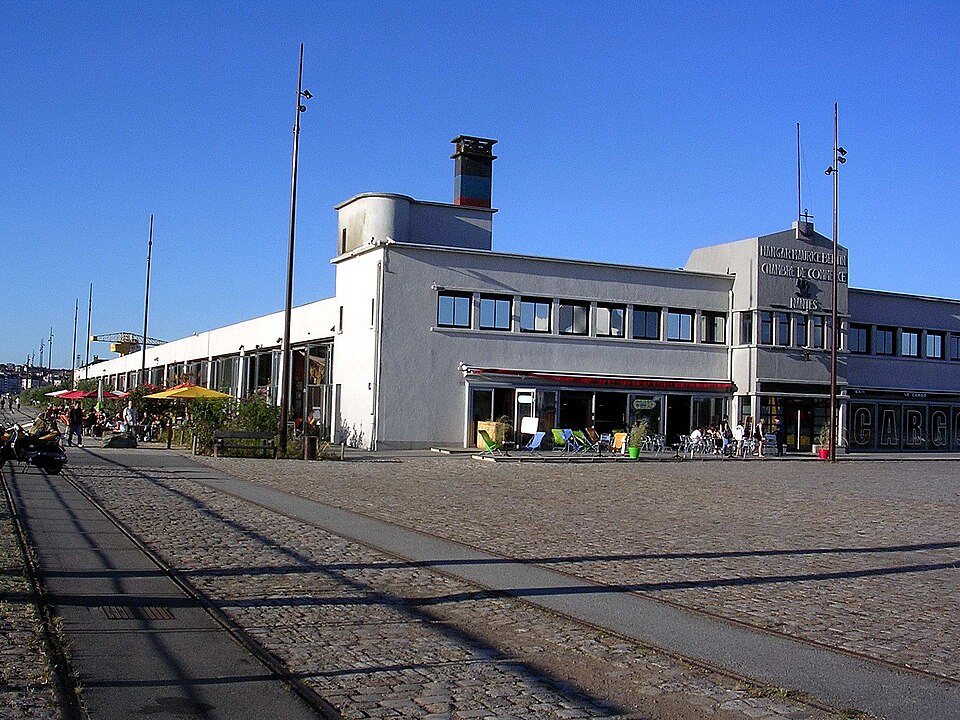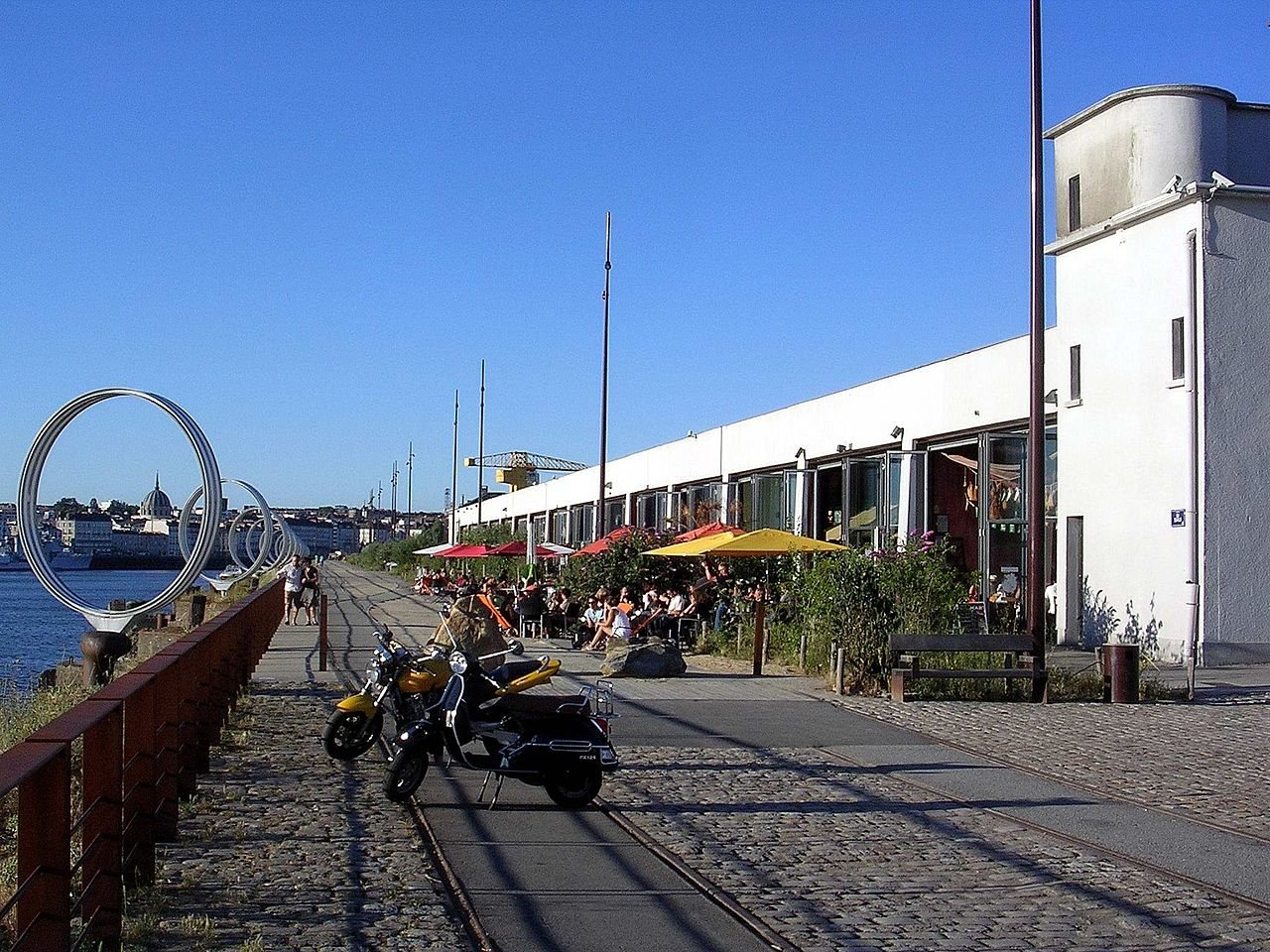
Bananas from the Canaries, West Africa and the Caribbean were ripened in this shed. It is now a row of bars and restaurants along the western tip of the Île de Nantes, facing the water.
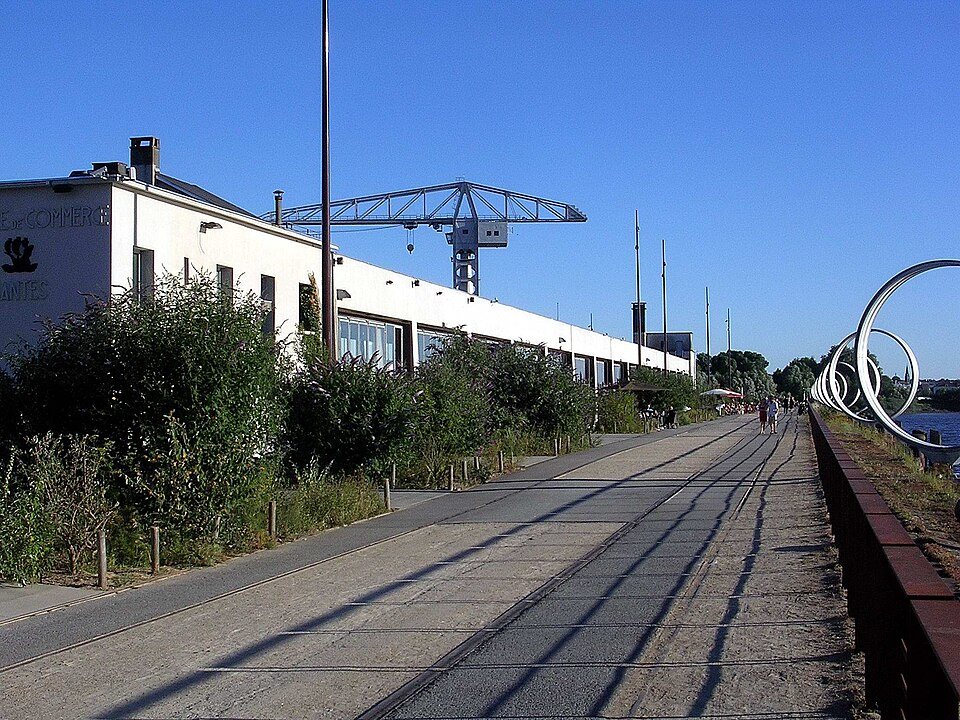
Outside it stand Daniel Buren and Patrick Bouchain's Anneaux — eighteen steel rings in a line along the quayside, each framing a piece of the Loire, each lit a different color after dark. They are free and permanent.
The old shipyard cranes still stand along this stretch, kept deliberately.
Come at dusk. The rings light up, the city is behind you and the estuary runs away to the west.
Hangar 21
The Hangar à Bananes is the everyday name for Hangar 21 of the port of Nantes-Saint-Nazaire, also called the Maurice-Bertin shed, on the Madeleine arm of the Loire at the western tip of the Île de Nantes. The banana trade boomed after the First World War, and Nantes was one of France's main ports for colonial produce. The original shed was built in 1901 and from 1929 served as a ripening house for imported bananas, the first bunches arriving from the Canary Islands.
The Allied bombing of September 23, 1943 destroyed it, and the chamber of commerce rebuilt it in 1949: more than 150 meters long and 50 meters wide, with about 8,000 square meters of fully climate-controlled storage and the most modern handling equipment of the day. Its pediment still carries the name of Maurice Bertin, president of the chamber of commerce and the driving force behind the port's postwar revival, and the facade is typical of reconstruction architecture.
Twenty dockers to a ship
After the war the bananas came from Guinea, and after Guinea's independence in 1958 from Guadeloupe, Cameroon and Côte d'Ivoire. Before the dock reform of 1992, dockers turned up each morning at the foot of the Butte Sainte-Anne to be hired for the day. In 1967 the port had between 800 and 1,200 of them, and it took twenty to unload a banana boat. The bunches, wrapped in straw and kraft paper, weighed 25 to 30 kilos; in the hold eight men filled bucket conveyors that carried them up to the shed, where they were sorted by brand and wheeled into temperature-controlled storage before being loaded onto trains. The work was fast, to compete with other ports, and the occasional viper came out of the bunches. Wages were paid the same day, and at the end of the week the dockers collected the rest at the bistro, where each gang foreman handed out the bonuses.
The independence of the new African states drew the trade away to other ports, despite the port authority's efforts to promote Nantes, the skill of its handlers and the shed's position next to the wholesale market and the Gare de l'État. The banana trade ended in Nantes before 1975. The shed then stored sugar for the Béghin-Say refinery and was gradually abandoned as the port moved its business downstream.
A second life
The building was restored between September 2006 and June 2007, with a deliberately light touch, as part of the redevelopment of the Île de Nantes. The idea was to make a lookout over the Loire, the quai de la Fosse, Trentemoult and Chantenay, where people could eat, drink and dance in different atmospheres, on the model of the warehouses of Lisbon. The plans were drawn by the Roulleau practice with Alexandre Chemetoff, who was in charge of redeveloping the island. It opened in June 2007 with bars, restaurants and a nightclub, a theater from 2013, and space for the Estuaire art biennial devised by Jean Blaise. In May 2021 the regional contemporary art collection, the Frac des Pays de la Loire, opened a new exhibition space here.
The rings
Les Anneaux, by Daniel Buren and Patrick Bouchain, were made for the Estuaire contemporary art festival of 2007, with the businessman Patrice Coupechoux as patron, and stand along the railing of the quai des Antilles, close to the gray Titan crane. There are 18 rings of galvanized steel, each four meters across, fixed to old mooring bollards at equal distances, and at night LEDs light them in alternating red, green and blue. Buren left them open to interpretation, but he tied them to the city's history: they recall the shackles that bound enslaved people in the triangular trade of which Nantes was the hub, and also wedding rings joining river, sea and land. The authorities suspect that some falls into the Loire here are caused by young people jumping through the rings; do not try it. Traders in the area have also complained that the city was slow to deal with safety at night, when the bars here are busiest.
Sources
Hangar à Bananes & the Rings in pictures