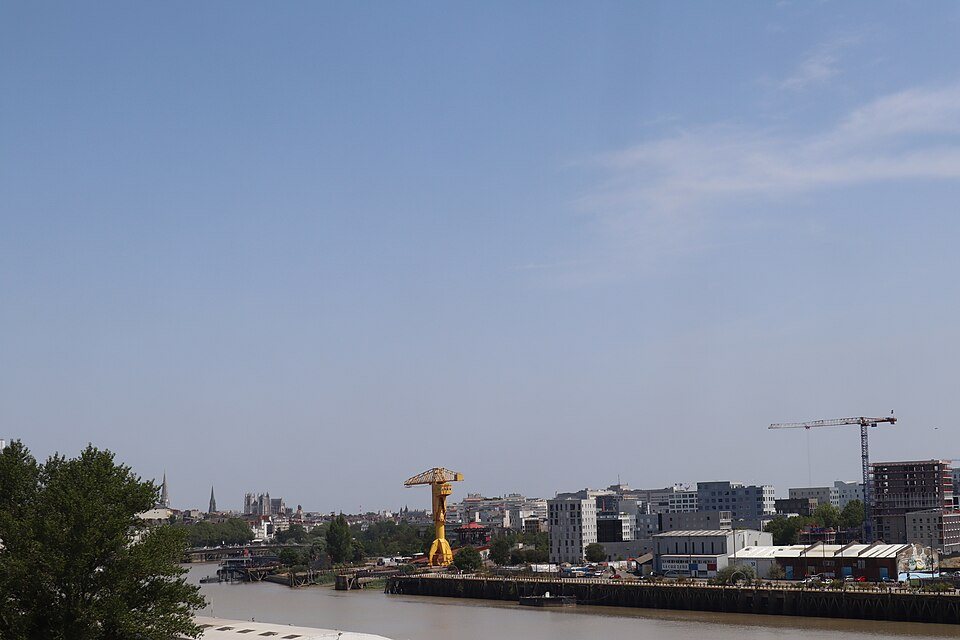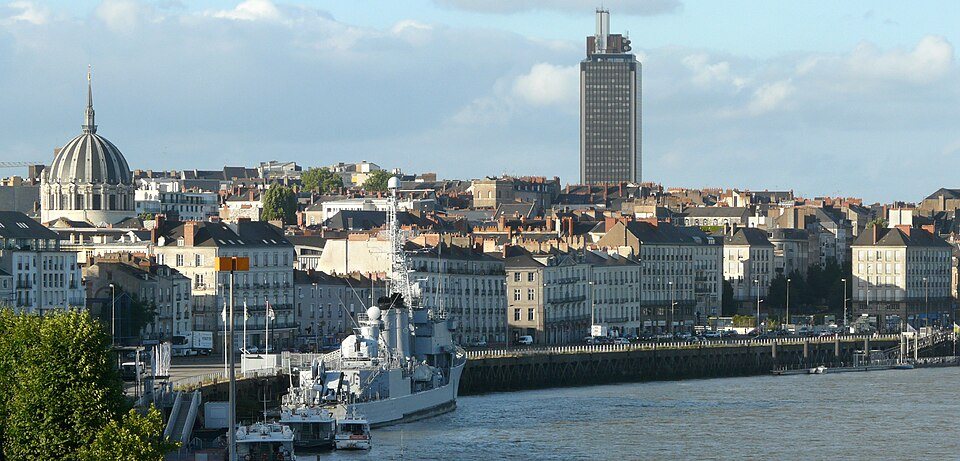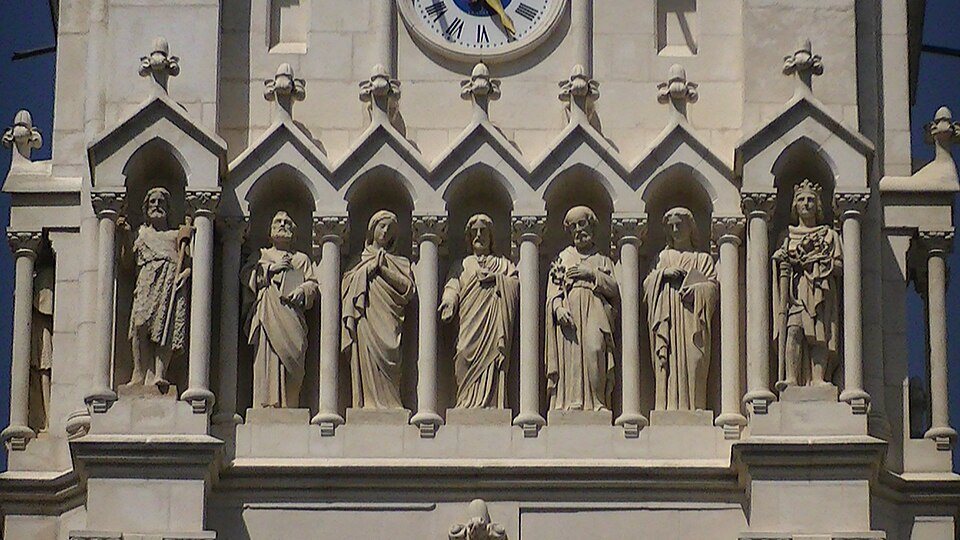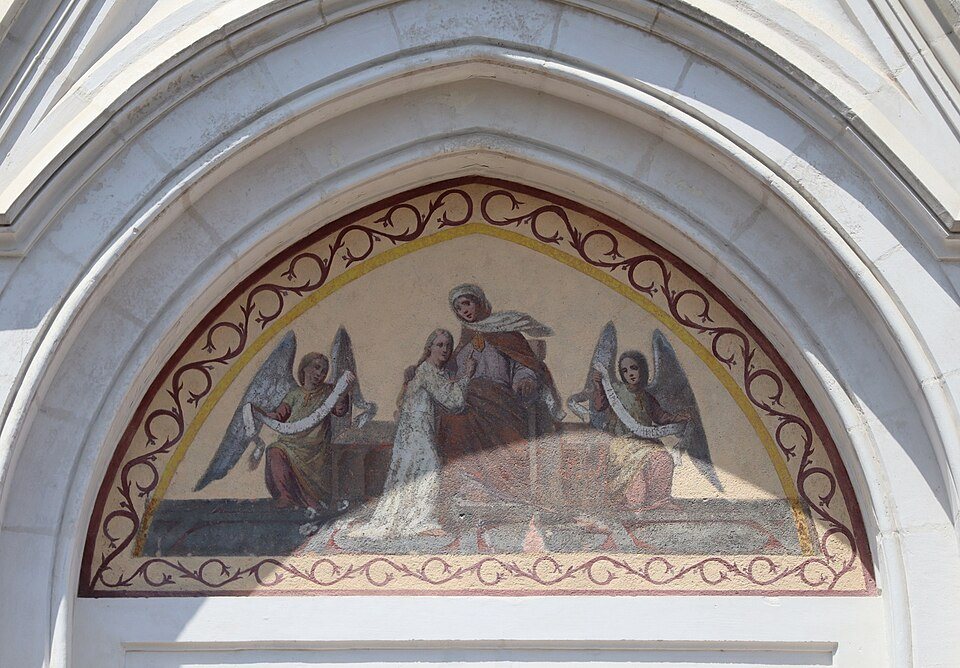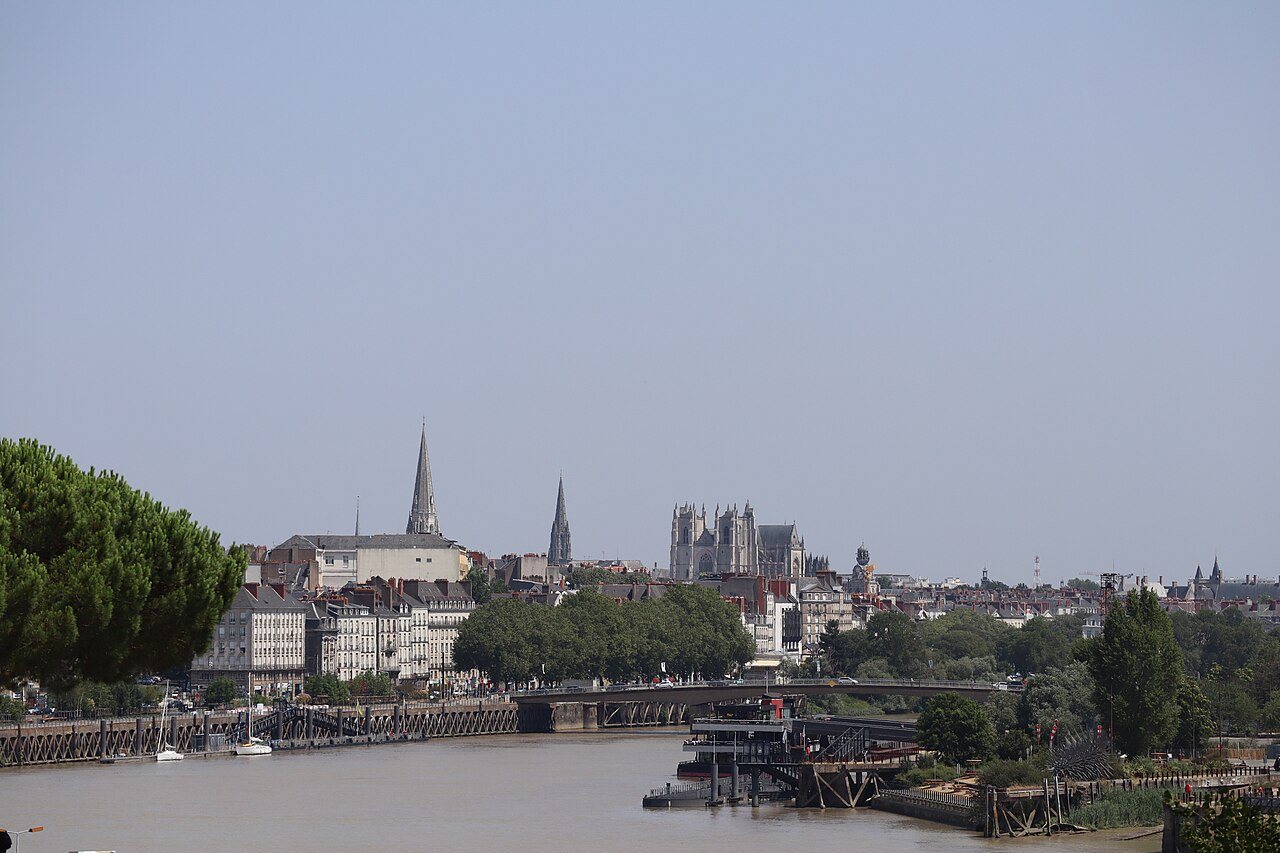
The ground rises sharply west of the center, and from the terrace by Sainte-Anne church you look straight down the Loire — the island, the cranes, the bridges, the estuary heading for the sea.
It is a residential quarter of steep streets and long staircases, and the walk up from the quay is genuinely steep.
The Jules Verne museum is up here, which is not a coincidence: this is the view that produced the books.
Free, and the best view of the river in the city. The tram will get you most of the way up if the hill is not appealing.
Orchards, a quarry and the salt
Until the eighteenth century the Butte Sainte-Anne lay well outside Nantes, a hill of orchards and vines in the parish of Chantenay, administered by the lordship of La Hautière, which worked the quarry at its foot from the fifteenth century. As the port moved downstream and the town spread west beyond its walls, the riverbank filled with shipbuilding. The Cacault plan of 1756 shows the heights still empty but a salorge on the shore, a warehouse where salt was stored before sale under the salt tax; the name survives in the Salorges district and the Salorges center, seat of the chamber of commerce. At the Revolution Nantes absorbed part of Chantenay, and the rest in 1908. The hill was built up in the nineteenth century and was badly hit by the bombing of 1943.
A hundred steps, then 122
The quay below, the quai Marquis-d'Aiguillon, was laid out after 1763 as a road that would spare carts the climb up the hill. Besides the port it drew blacksmiths and washerwomen, many of whom lived up in the Hermitage quarter on the slope above, reached only by an awkward stair of several sections known as the hundred steps. In 1837 the residents asked for something better, and in 1850 the city architect Henri Driollet built the monumental Sainte-Anne staircase of 122 steps, climbing about 30 meters from the quay to the rue de l'Hermitage and the Place des Garennes.
The upper part, from 1850, runs straight up toward the church of Sainte-Anne in four flights, with granite landings, a wrought-iron handrail and six lamps; side passages lead to the properties along it, among them the Jules Verne museum. The lower part, parallel to the river, dates from the 1970s, when the old railway along the quay was removed and the road widened.
The quay's name has its own small history. It honors Emmanuel-Armand de Vignerot du Plessis, Duke of Aiguillon, commander-in-chief in Brittany from 1753 to 1758, and in 1763 the town council decreed that his name, the date and his arms be carved on a stone. During the Revolution it became the quai Palamède, and afterwards people called it either the quai d'Aiguillon or, wrongly, the quai de l'Aiguillon, the goad; in 1990 the city renamed it the quai Marquis-d'Aiguillon to end the confusion, though nobody knows why it chose marquis rather than duke.
Saint Anne blessing the river
In 1851 the parish priest offered to pay for a statue of the saint if the staircase took her name. Designed by Amédée Ménard and cast in iron by Jean-Simon Voruz, the statue at the top of the steps was inaugurated and blessed on April 22, 1851. Saint Anne stands with the young Mary at her side and stretches her right arm toward the Loire, as if blessing it. The whole monument is just under eight meters high, on a pedestal of local granite, the pierre nantaise, given by the city.
Railways and a mill
In 1857 the Nantes-Saint-Nazaire railway was laid along the quay, and 64 houses were demolished to make room, which is why buildings now stand only on the landward side; a section of rock at the Misery quarry was cut away, and the staircase gained a large landing to bridge the tracks. Plans to carry the line on an elevated viaduct, like the overground stretches of the Paris metro, were put forward in 1899, 1904 and 1926 and never built; the rails were taken up in the 1950s once the Chantenay tunnel opened.
Below the hill, between the river and the railway and facing the old Misery quarry, Paul Perraud set out in 1894 to build a steam flour mill, the Grands Moulins de Loire, meant to grind 400 tonnes of wheat a day. It was the first building to use the Hennebique reinforced concrete system on such a scale, but the company went bankrupt in 1899; the building is now planned as the new home of the Jules Verne museum. On April 4, 1973, the cargo ship Pointe-Madame, launched from the Dubigeon yard on the opposite bank, crashed into the quay.
Sources
Butte Sainte-Anne in pictures