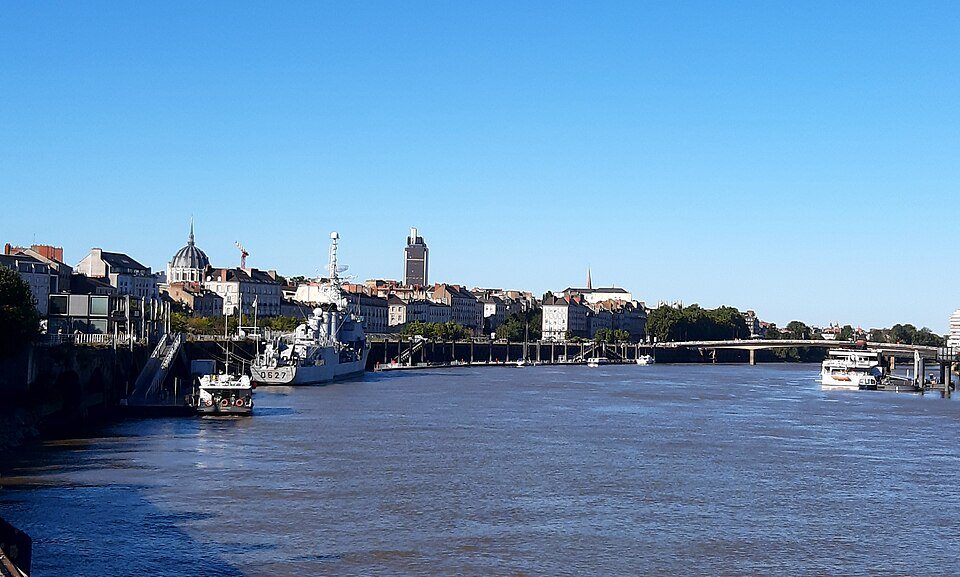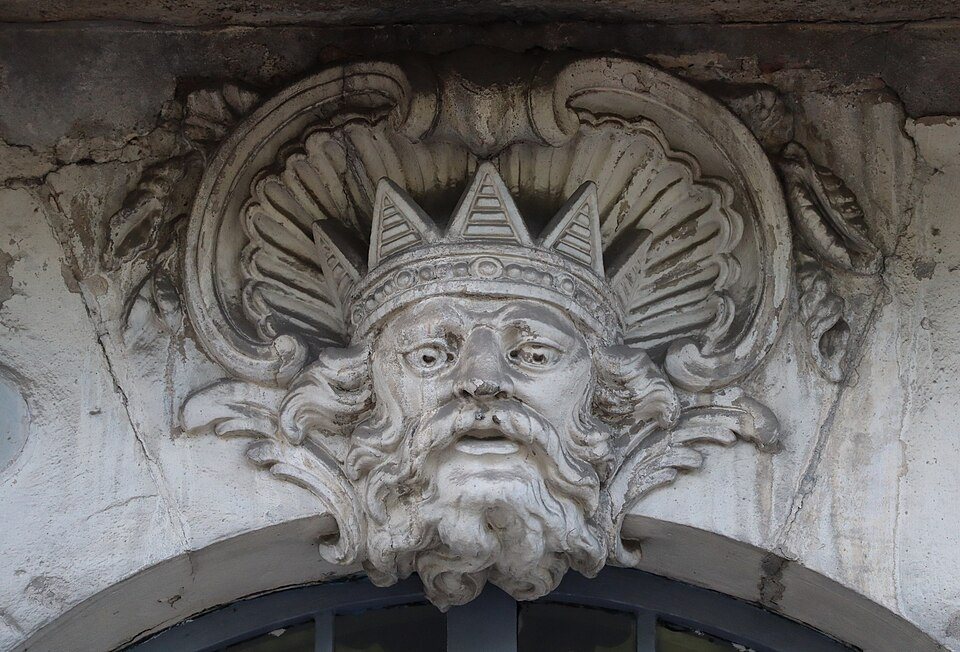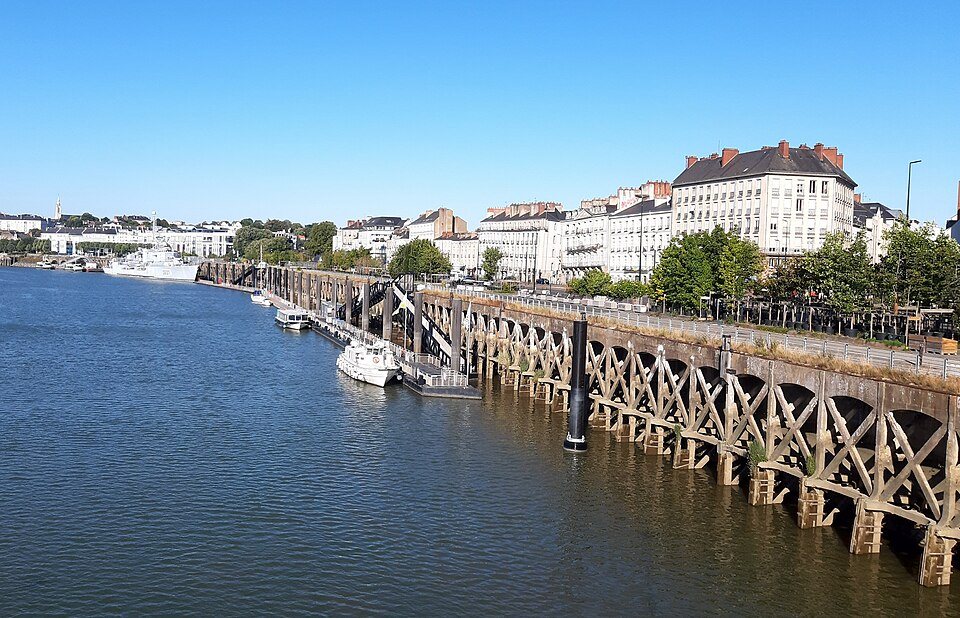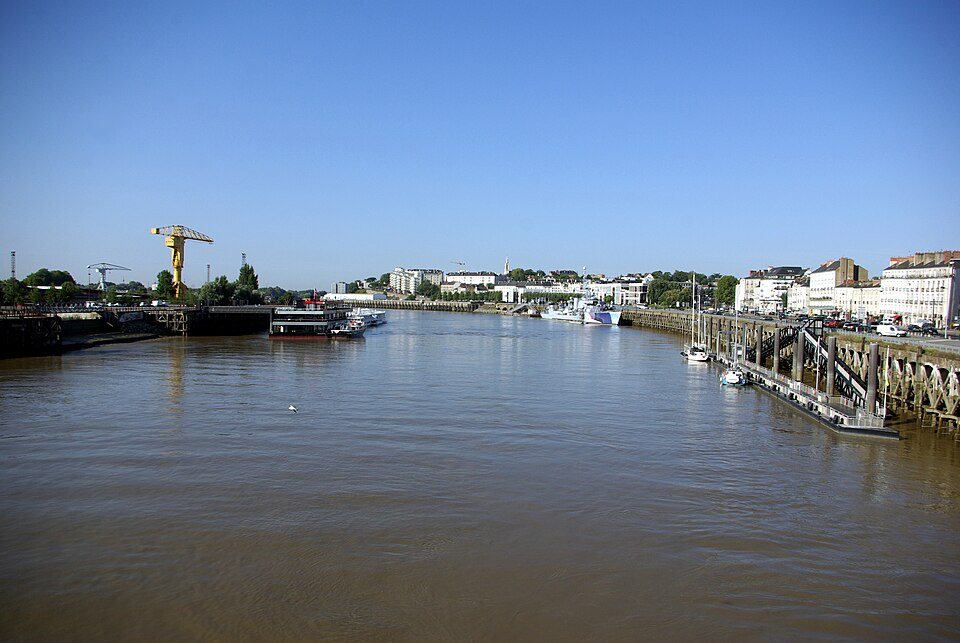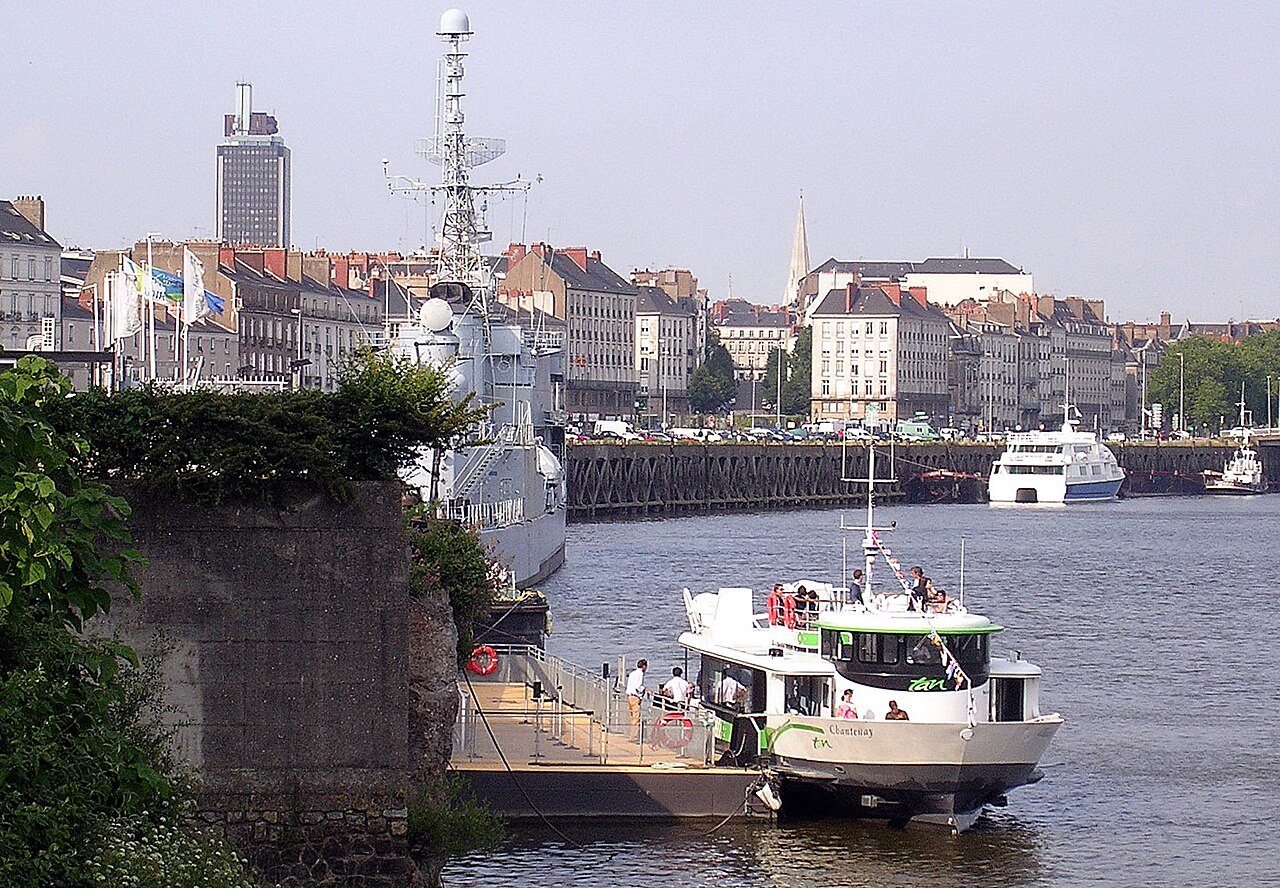
This was the commercial waterfront. The tall eighteenth-century houses along it were built by shipowners and merchants, and their decoration — carved heads, ironwork, mascarons — is a direct expression of what the port earned.
The memorial runs along this quay, which is deliberate: it is on the ground the ships left from.
Further west the quay runs on towards the Butte Sainte-Anne and the old Gare Maritime, where the river shuttle to Trentemoult leaves.
Read the buildings and the memorial together. Separately, each tells you half of what happened here.
A quay on a channel
The Fosse is the name of a natural shallow channel cut by the Loire that runs along the quay and once reached the foot of the stock exchange on the Place du Commerce. The quay stretches more than 1,100 meters along the right bank, from the Place de la Bourse west to the Place de Jacksonville. Its western two-thirds still face the Loire; along its eastern 400 meters the river was replaced in the 1930s by the embankment created when the Bourse and Hôpital arms of the Loire were filled in.
The name is old. In 1442 Duke Jean V granted a tax exemption to a man who owned a house at Couëron and another at la Fosse de Nantes, land that came under the bishop of Nantes until 1789. The first quay was built in 1516, on the bishop's land, among fishermen's huts. King Charles IX was received here in 1565 by the richest merchant in the city, André Rhuys, in his Maison des Tourelles, and popular tradition holds that Henri IV signed the Edict of Nantes in the same house in 1598. It was destroyed by the bombing of September 23, 1943.
The slaving century
Transatlantic trade, driven above all by the triangular trade, swelled the traffic in the seventeenth and eighteenth centuries. A new stone quay was built in 1622 and extended in 1624, giving the Fosse more than 600 meters of stone quay. When the mayor Gérard Mellier had the facades aligned in 1724, the district held a quarter of the city's population. At number 56 the Montaudouin family built their town house at the heart of the merchant quarter; in 1725 they were the richest family in Nantes, having fitted out half of the city's slaving expeditions between 1716 and 1722.
Like those on the Île Feydeau, many of the shipowners' mansions are built of tuffeau, and some lean visibly because of the marshy ground beneath them. Their mascarons, the carved faces over windows and doors, show sometimes maritime themes and sometimes Bacchic ones.
Trains, sailors and decline
In 1853 the railway to Saint-Nazaire was extended along the quay, changing it for nearly a century, with a station at each end, the Gare de la Bourse to the east and the Gare Maritime to the west for port freight. During the First World War the Americans asked for the single track to be doubled, and here it became a third track. The railway left the quay only when the Chantenay tunnel was finished in 1955. The port's activity slowly moved downstream to the quai Wilson and the terminals at Cheviré and Roche-Maurice, and the last warehouses on the quay, sheds 7 and 8 built in 1910, were demolished in 1997.
A sailors' quay had a sailors' reputation, and the people of Nantes nicknamed it the quai de la fesse for the brothels in the streets behind it. The quay appears in Jacques Demy's Lola, filmed here in 1960.
Buildings to find
At number 24 is the Jacques-Demy media library, the largest in the city, opened on October 1, 1985. At number 55, beside the memorial, is the only building on the river side of the quay: the former harbor master's office, built in 1884 and used by the port until 1980, now the Maison de la Mer, home to sixteen maritime associations. At the western end, the remains of the old salorges, the salt stores, recall another of the port's trades.
What is gone, and what is remembered
Several landmarks did not survive. Besides the Maison des Tourelles, the customs house of around 1770, attributed to Ceineray, stood at number 37, and the gateway of the Sanitat hospital was destroyed in 1943. At number 32 the lithographer Pierre Henri Charpentier set up his workshop in 1828, on the site the media library now occupies.
Jules Verne, born in Nantes in 1828, looked back in 1891 on the river of his childhood in his Souvenirs d'enfance, recalling the Loire and its many arms linked by a league of bridges. The memorial on the quay counts more than 1,800 slaving expeditions from the port of Nantes and 550,000 Africans deported, out of 4,220 expeditions from all French ports.
Sources
Quai de la Fosse in pictures