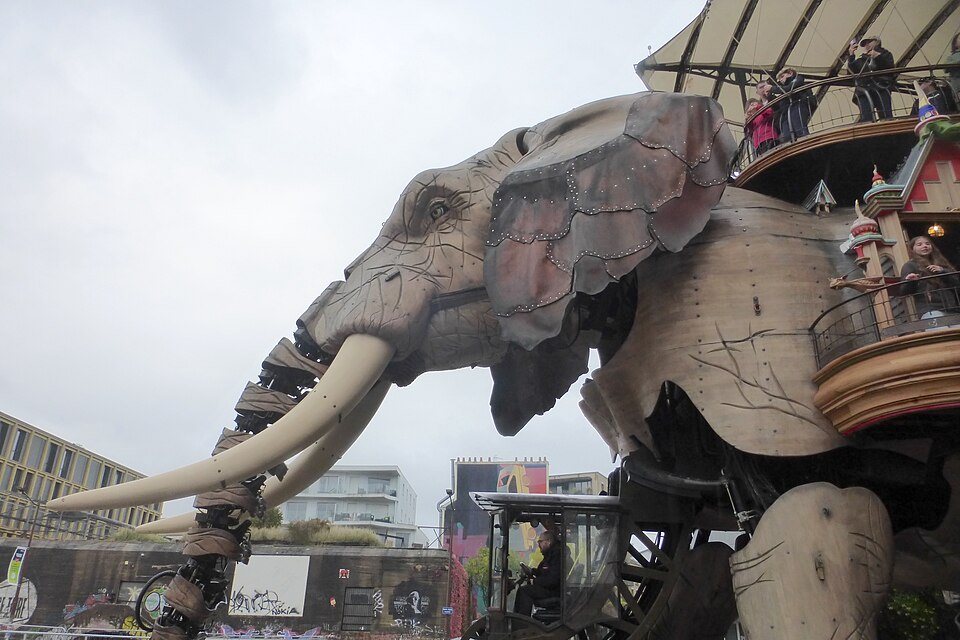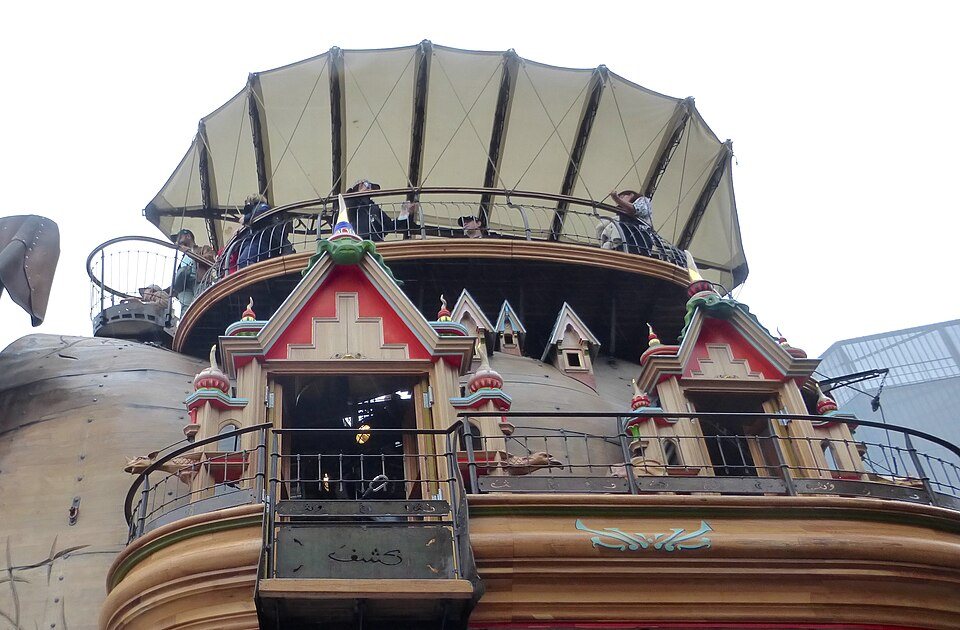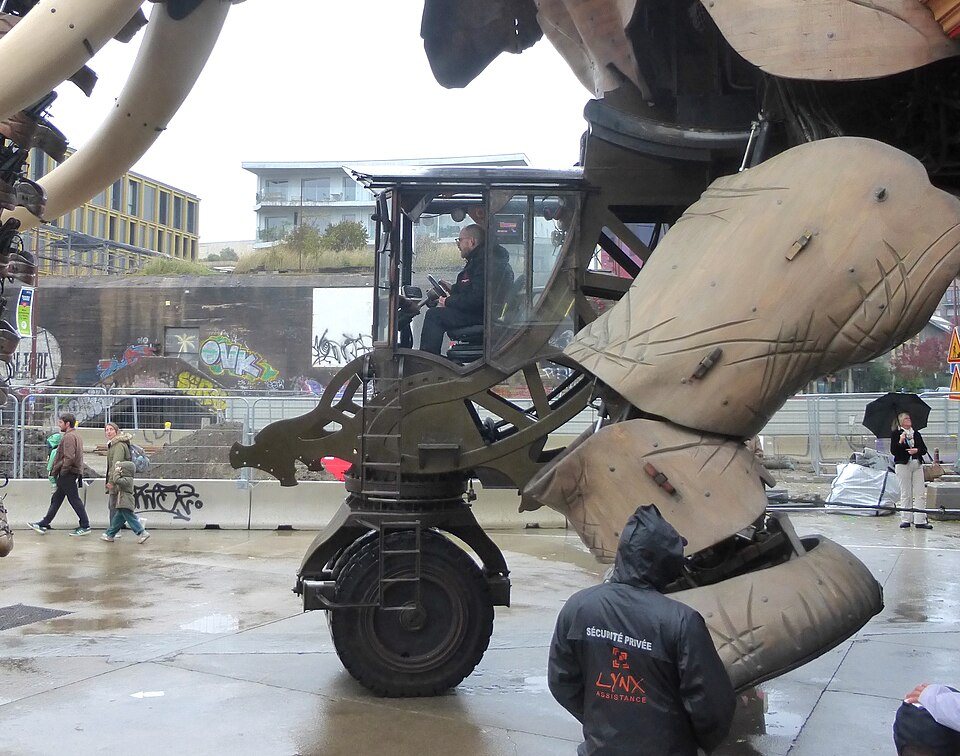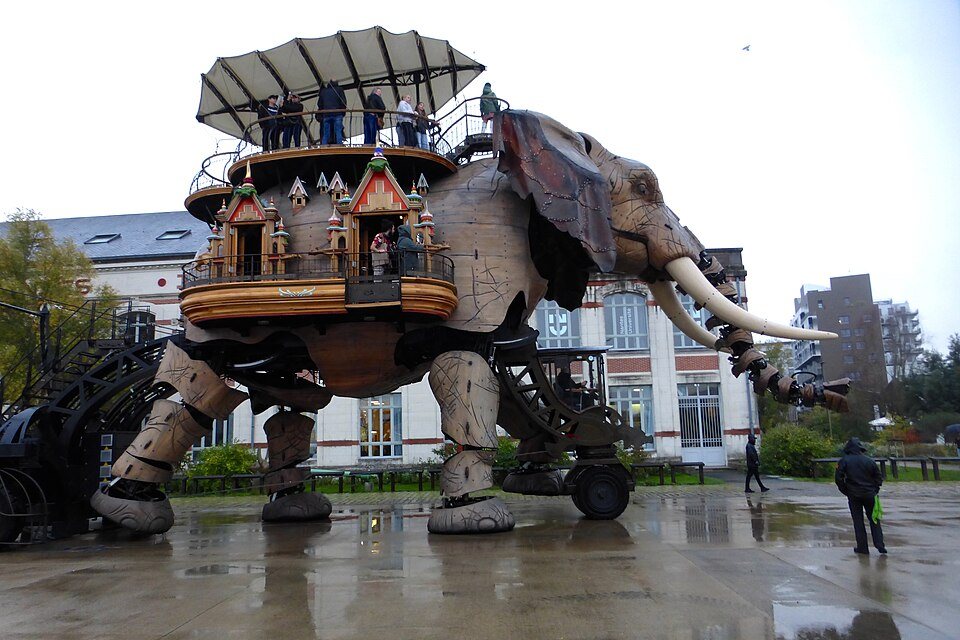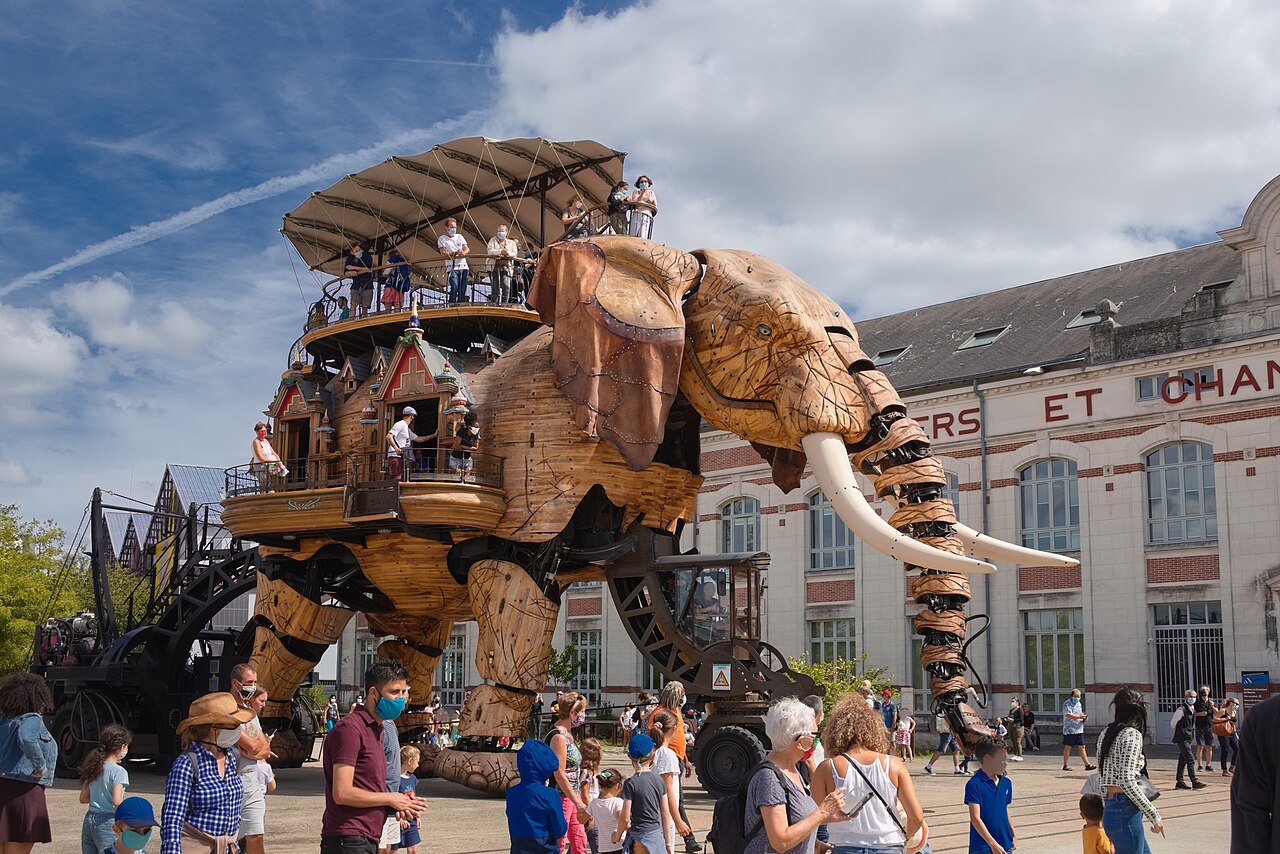
The Grand Éléphant looks like a single machine, but it's really a small crowd of people hiding inside a wooden and steel skeleton. Understanding that changes how you watch it. Once you know where the "engine room" is and how the legs actually move, the whole thing stops looking like a parade float and starts looking like what it is: a piloted vehicle with a skin made of poplar planks.
What's actually moving under the skin
The elephant stands several stories tall and walks on four legs that never all leave the ground at once, which is why the gait looks slow and rolling rather than bouncy. Inside the body, a small team operates the machine from a cabin: someone drives, someone manages the trunk, ears, and eyes, and others handle the mechanical sequencing that keeps the legs from fighting each other. The motion is hydraulic, not magical, but the wooden cladding hides almost all of the machinery, so from outside you mostly see joints flexing under skin-like panels rather than pistons.
The trunk is the part people remember. It curls, sprays water over the crowd near the Île de Nantes waterline, and can lift its tip well above head height. The ears flap, the eyes blink, and the whole animal occasionally trumpets — a sound cue timed to the walk rather than random noise. None of this is improvised in the moment; it's a rehearsed sequence, which is why the same gestures tend to repeat on each circuit.
If you want to understand the engineering rather than just watch the spectacle, the workshop visit inside the same complex shows unfinished machines and half-built mechanisms from the same team that built the elephant. It's the best way to see the skeleton without the skin.
Where to stand for the ride and the walk
There are two separate experiences here, and mixing them up is the single most common mistake visitors make. One is riding the elephant, seated on a platform on its back for a slow circuit. The other is watching it walk, for free, along its outdoor route on the Île de Nantes. Riders board at a fixed platform near the machine's shed; the operator controls how many people go up per circuit, and demand shifts with the season, so treat any queue estimate you hear secondhand as unreliable and check current boarding conditions directly with Les Machines de l'Île before planning your day around it.
For watching without riding, the best fixed vantage points are along the paved plaza where the elephant begins and ends its loop — you get a clean sightline as it turns, which is the moment its full size actually registers. A second good spot is slightly back from the route, near the sheds themselves, because you catch it both departing and returning without fighting the density of the crowd that gathers right at the barrier.
Don't stand directly under the trunk expecting a photo op and end up soaked and annoyed — the water spray is a known and repeated part of the show, not a malfunction, and staff won't apologize for it. If you're carrying a camera or a phone you care about, stand a few feet back from the front-row line.
The elephant does not run constantly through the day; it operates in cycles with rest periods for the machine and crew. Rather than guessing, check the day's operating schedule at the entrance or on the official Machines de l'Île channels before you commit to waiting.
Reading the route and the rest of the site
The elephant walks a loop through the Machines complex, which sits within the larger Machines de l'Île site on the former shipyards of the Île de Nantes. That location matters: this isn't a theme park built from scratch, it's staged inside the old Nantes shipbuilding infrastructure, and the cranes and gantries around the elephant's path are leftover industrial structure, not stage set. If you're interested in that layered history — shipyards turned into a fantasy-machine workshop — it's worth pairing this visit with a broader look at the port's history along the Loire.
The Carrousel des Mondes Marins, a separate multi-level mechanical carousel on the same site, is often visited back-to-back with the elephant, and the two share the general Voyage à Nantes spirit of turning engineering into public performance — a thread that runs through much of the city's contemporary art trail described under Voyage à Nantes.
Getting to the Île de Nantes is straightforward by tram, and the stop nearest the Machines complex puts you within a short walk of the sheds; details on lines and stops are covered in Getting Around. If you're building a longer day around the river and its industrial past, the nearby Hangar à Bananes and the general stretch of the quay make a reasonable extension once you've seen the elephant walk its loop.
Arrive with enough time to walk the full perimeter of the outdoor route once before deciding where to plant yourself — the elephant's path isn't a straight line, and the far end of the loop is often far less crowded than the boarding plaza, with just as good a view of the legs in motion.
For anyone assembling a first full day in the city, the elephant tends to anchor an afternoon rather than a whole day; it pairs naturally with a river walk or a visit to the Château des ducs de Bretagne earlier on, since both sit within a manageable stretch of central Nantes. See Itineraries for how other visitors have sequenced it.
In pictures