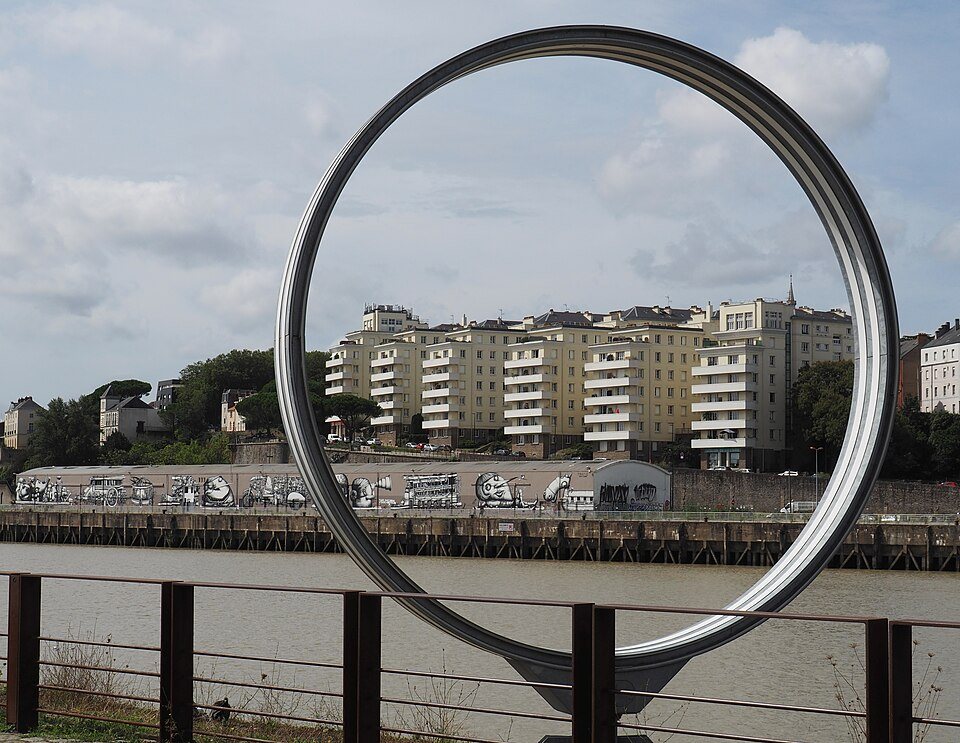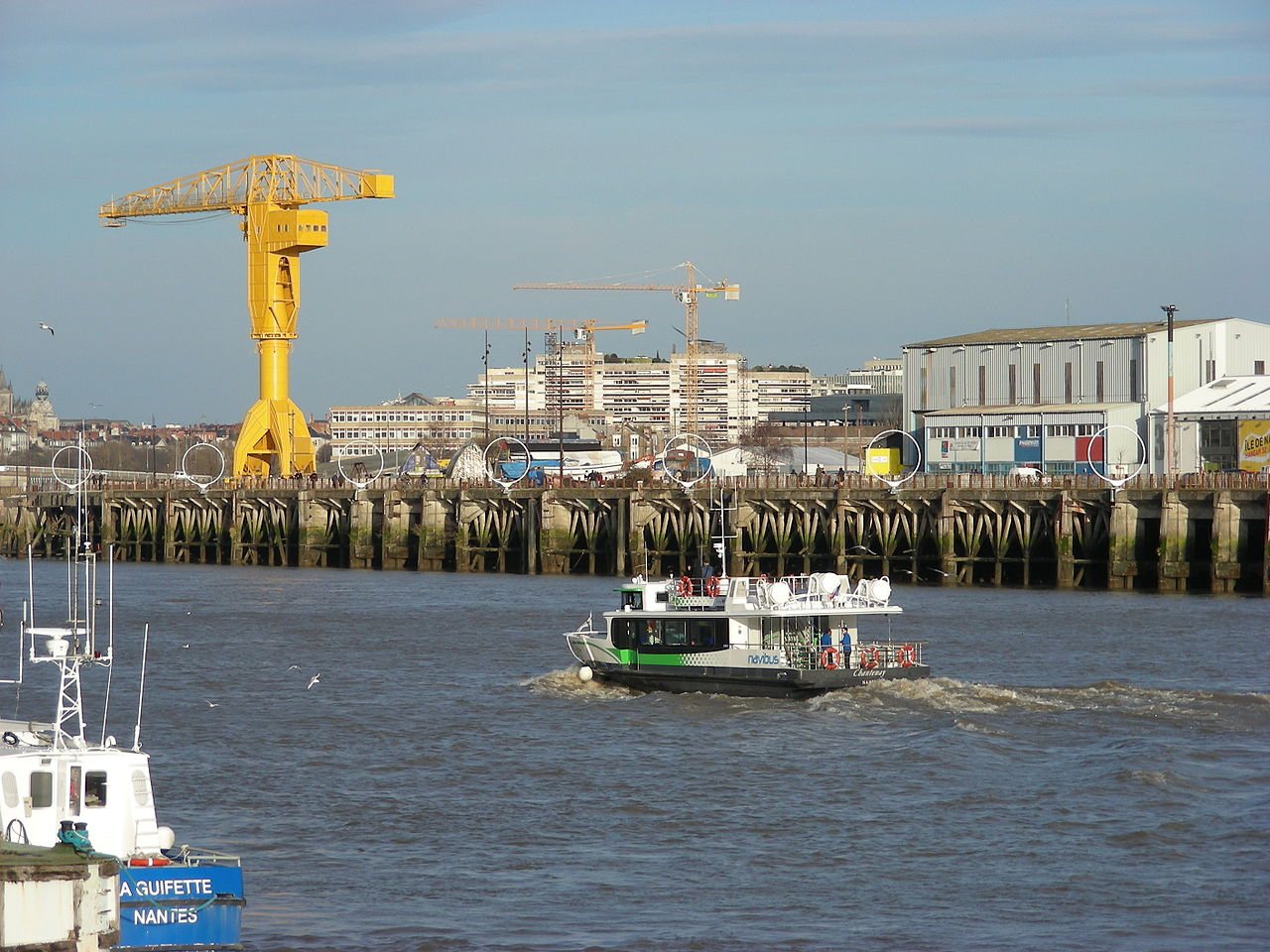
Walk the riverbank on the Île de Nantes at dusk and you'll see them before you can name them: a line of steel rings, each taller than a person, planted along the quay like a chain someone dropped and forgot to pick up. These are the Anneaux de Buren, eighteen rings strung along roughly 1,300 feet of the Loire's edge at Quai des Antilles, and they are one of the few pieces of public art in Nantes that locals will actually bring up unprompted, usually to explain the color.
What they are
The rings were designed by the French conceptual artist Daniel Buren, working with architect Patrick Bouchain, and installed as part of the Estuaire art trail that once ran from Nantes to Saint-Nazaire. Most of that trail's temporary pieces have since disappeared, but the rings stayed, and they're now folded into the permanent open-air collection that Voyage à Nantes maintains across the city. Buren is best known elsewhere for the striped black-and-white columns in the courtyard of the Palais-Royal in Paris, and the same instinct for turning a plain civic space into something you have to walk through shows up here: the rings don't sit behind glass or on a plinth, they're simply part of the quay, and people cycle, run, and walk dogs straight through the installation without a second thought.
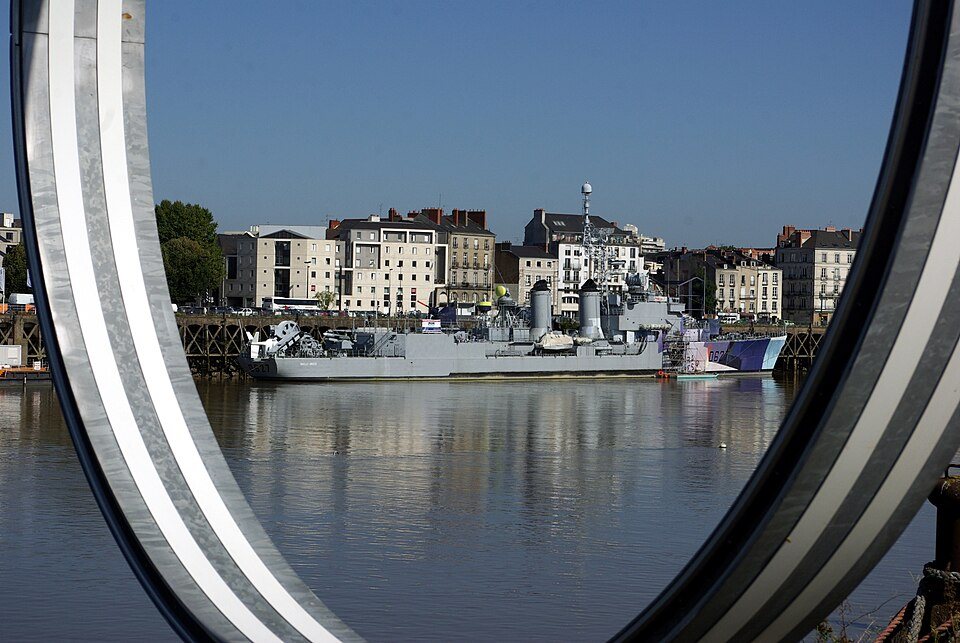
Scale is part of the point. Up close, the rings are big enough to frame the river and the opposite bank like a sequence of viewfinders — stand inside one and the Loire fills it. From a distance, especially walking the length of the quay, they read as a single rhythmic gesture rather than eighteen separate sculptures, each slightly different in height and diameter, following the curve of the bank.
Why the colors change
This is the detail that gets repeated most. At night, the rings are lit, and the lighting isn't fixed to a single color scheme that runs on a loop — it's tied to the tide. The Loire at Nantes is a tidal river; the water level at the quay rises and falls with the tidal coefficient, a daily measure of how strong the tide is. The idea behind the piece, as it's generally explained around the installation, is to make that invisible rhythm visible: the illumination shifts according to the state of the tide, so the rings become a kind of slow-motion readout of the river's mood rather than a static light show. It's a quiet way of reminding a city that often forgets it's a port that the Loire here is still doing what oceans do — rising, pulling back, rising again — even if you can't easily tell by looking at the water itself.
Don't expect to decode the exact logic on the spot; the appeal is more in noticing that the color is different from the last time you walked past, not in cracking a formula. If you're curious about the specifics of the lighting program on a given evening, that's a question for Voyage à Nantes rather than something worth guessing at here.
Where to stand, and when to go
Quai des Antilles sits on the Île de Nantes, a short walk from the Hangar à Bananes, and most visitors arrive at the rings as a byproduct of heading toward the giant mechanical elephant and the rest of Les Machines de l'Île, which are a few minutes further along. That's not a bad way to do it: see the rings at whatever hour the light is doing something interesting, then carry on to the workshop. The quay is flat, paved, and easy walking, and there's no gate or entrance to navigate — you simply arrive at them.
Daytime visits show off the engineering: the rust-colored steel, the way each ring is anchored into the stone edge of the quay, the views they frame across to the opposite bank near Quai de la Fosse. After dark is when the color becomes the story, and the rings are easiest to appreciate on an evening walk rather than a rushed stop between other sights — bring the kind of patience you'd bring to watching a sunset, since the whole point is a slow change rather than a flash.
The stretch of river here is also a reasonable spot to think about Nantes's history as a trading and slaving port before the Loire silted up and shipping moved downstream toward Saint-Nazaire; the nearby Memorial to the Abolition of Slavery, a little further along the bank, makes that history explicit in a way the rings themselves don't attempt to.
Getting there and what to pair it with
The Île de Nantes is connected to the city center by tram and on foot across the Loire's bridges; see getting around for the practical routes. The rings work well as one stop on a longer riverside walk that also takes in the Machines de l'Île workshop, the warehouses-turned-bars and restaurants at the Hangar à Bananes, and the view back toward the Loire and the old port quays. If you're building a half-day around the island, Access Nantes has a fuller rundown of options in itineraries.
One common mistake: treating the rings as a quick five-minute photo op on the way to the elephant and then forgetting them. The piece rewards a second look later in the trip, ideally after dark and at a different point in the tidal cycle than your first visit, when the color will have moved on without you.
In pictures