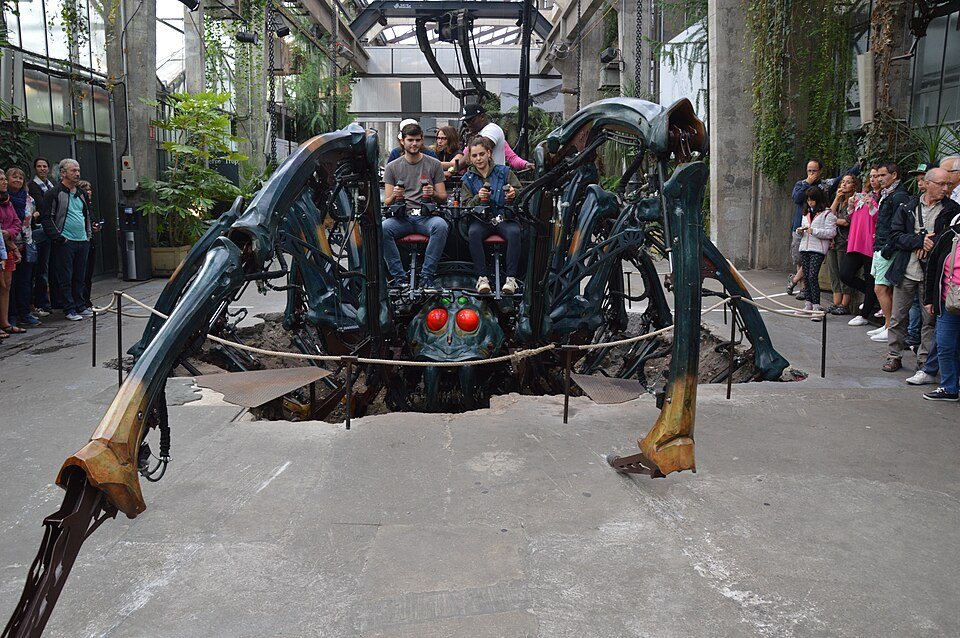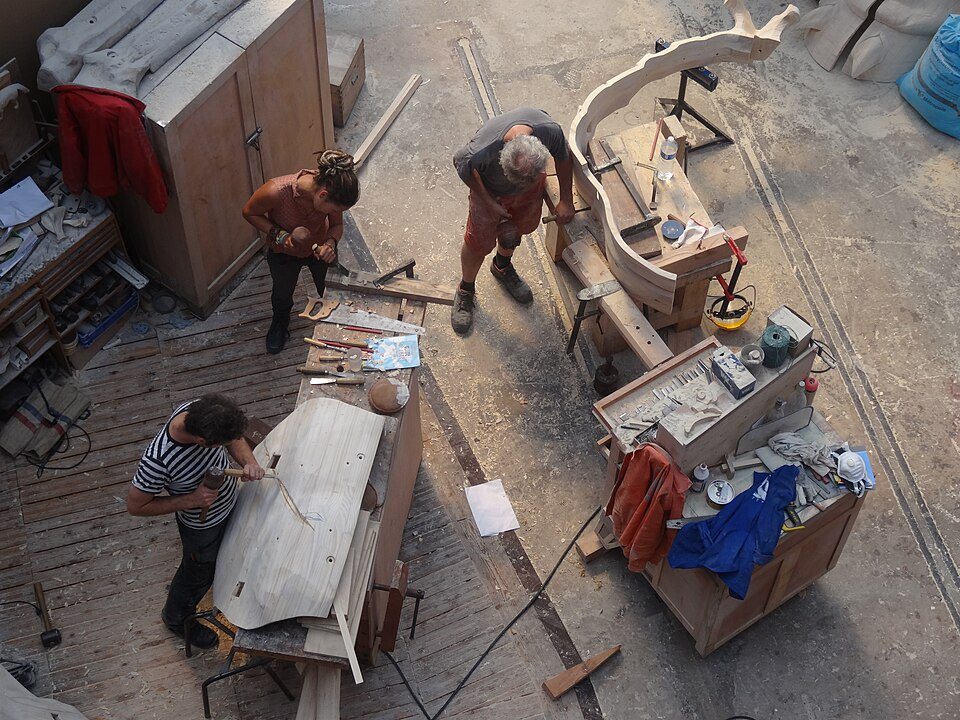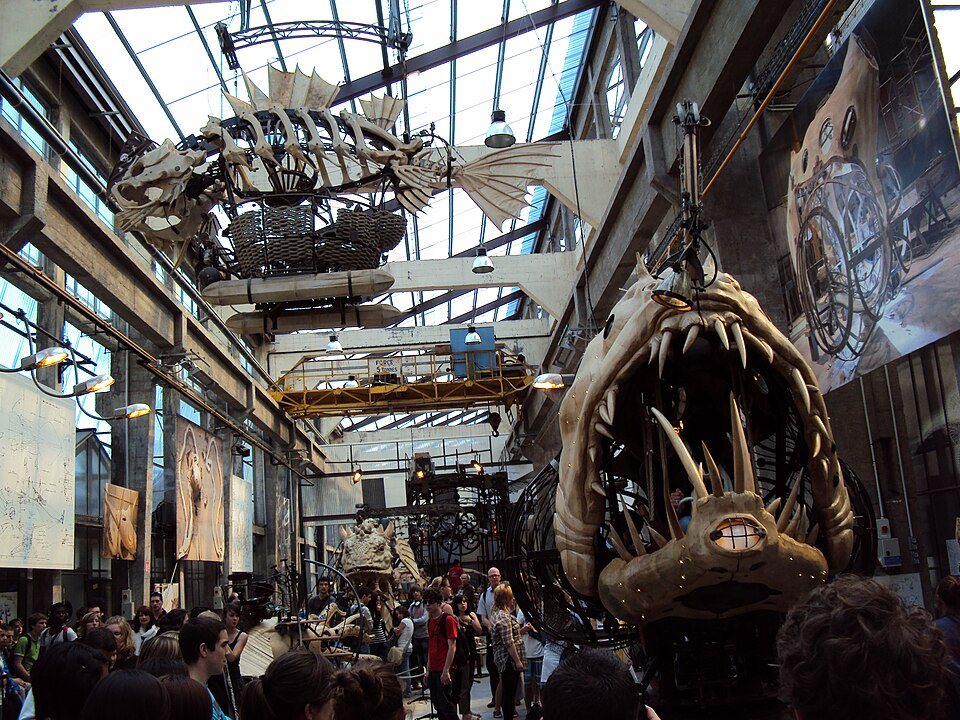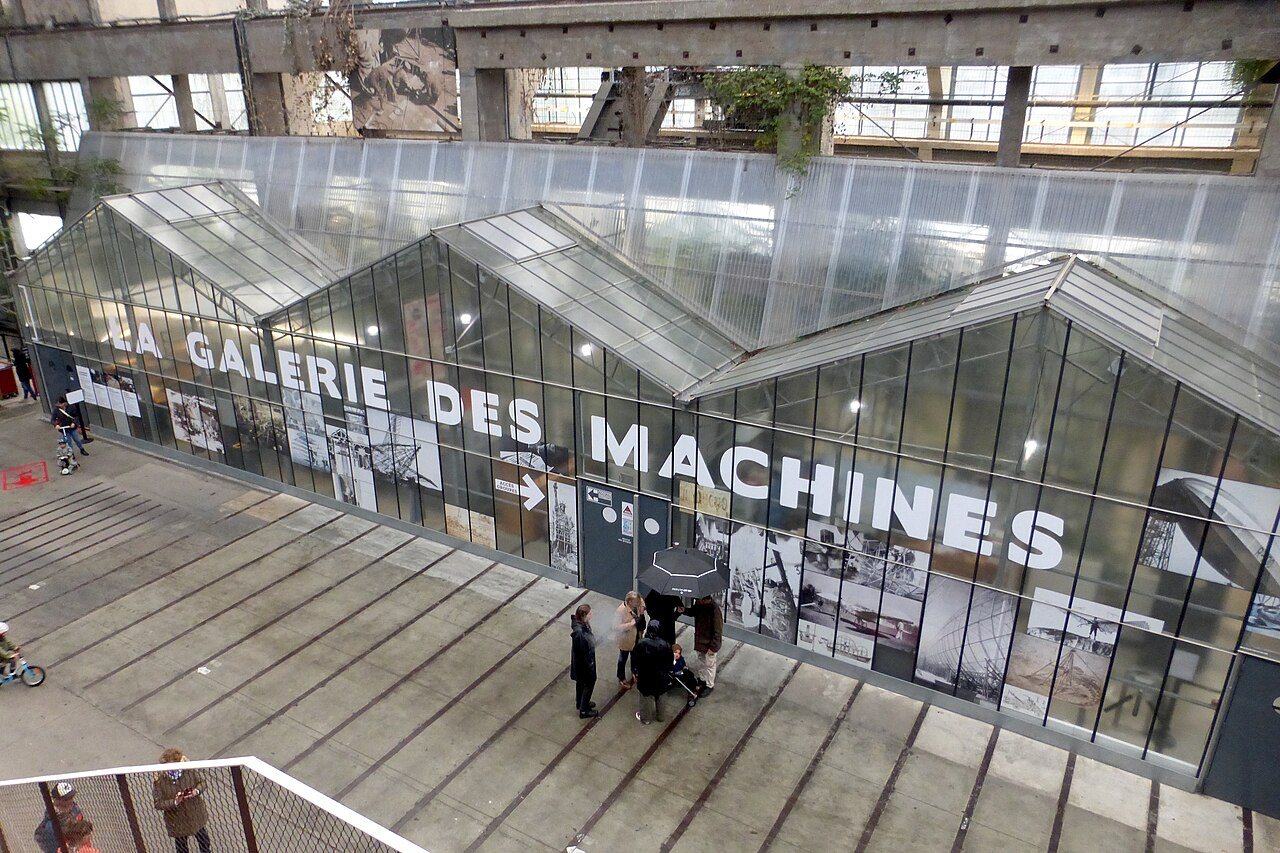
Most workshops hide the mess. The Galerie des Machines does the opposite: it puts the mess on display, behind glass and rope lines, so that anyone walking through can watch metalworkers, leather workers, and mechanics build a creature that doesn't exist yet. This is the part of Les Machines de l'Île that isn't a ride. It's a working shop floor, and the thing being built is often bigger than the room seems to allow.
What's actually happening on the floor
The Galerie occupies one of the old submarine-construction halls on the former shipyards, a building whose steel bones already look like something out of a Jules Verne fantasy before anyone touches them — fitting, since the whole project takes its imagery partly from Verne and partly from the biomechanical drawings of Nantes-born artist and set designer François Delarozière. Inside, the current build is laid out in stages: a skeleton of steel ribs on one side, a section with skin and articulation nearly finished on the other, and workbenches scattered between where individual joints, scales, or wing sections get shaped and tested before they're bolted to the whole.
The people doing this work are not performers pretending to be technicians. They're boilermakers, upholsterers, and hydraulics specialists who trained on shipyards or in theater workshops, and on a given visit you might see them welding, stitching thick canvas "skin" over a wooden rib, or running a hand-cranked test of a wing joint to check the pull of a hidden hydraulic ram. Go slow near the workbenches rather than the big silhouette in the middle of the hall — the small, patient work of fitting a single articulated toe or eyelid is often more interesting than the half-built giant it belongs to.
How to actually watch the build progress
The gallery is arranged so visitors move along an upper walkway and through ground-level bays, getting both the overhead view of a creature's full skeleton and the close-up view of a single mechanism being tuned. Because construction is genuinely ongoing — not a static museum display dressed up to look active — what's on the floor changes over months. A creature that was just ribs and cable runs on one visit might have full skin, paint, and a test walk under its own power by the next. There's no guarantee of catching a specific milestone; that unpredictability is part of what makes it feel like a real workshop rather than a performance.
Don't expect a guided narration of exactly what's being built or when it will move outside. Teams work on their own schedule, and information panels describe technique and materials more than they predict a finish date. If you want the fullest picture, pair the visit with a walk to see the finished machines already operating — the Great Elephant and the carousel structures on the Île de Nantes show you what the pieces on the workshop floor eventually become.
The Galerie also displays completed smaller machines and prototypes that never made it to full scale, or that were built as a proof of concept before a larger version was greenlit. These sit alongside the live build, so you can compare a finished heron wing mechanism, say, with the half-finished one being fitted a few meters away.
The link to the Marine Worlds carousel
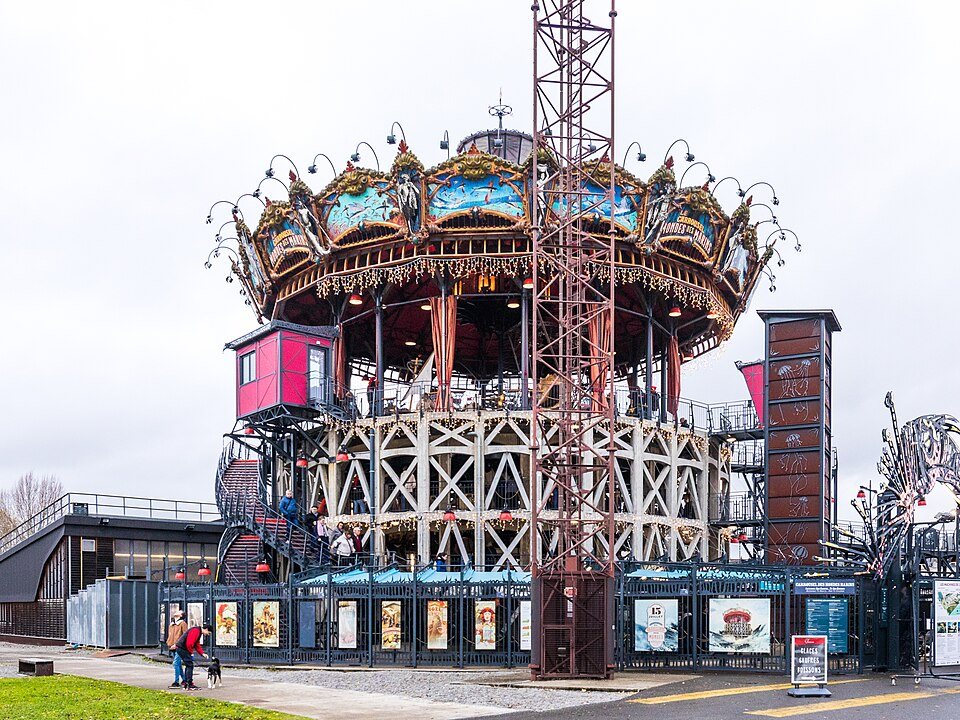
A good chunk of what gets built in the Galerie eventually feeds into the Marine Worlds carousel, a multi-level structure of deep-sea creatures — anglerfish, giant crab, manta ray shapes — each one rider-operated by cranks and levers rather than a fixed motor cycle. Before those creatures were installed on the carousel structure, most of them existed first as skeleton-and-skin builds in this same hall, tested for weight, balance, and the specific feel of the hand controls that let a rider make a claw open or a fin beat. Watching an unfinished mechanism in the Galerie gives you a sense of how much manual, non-electronic control is designed into machines that later look almost alive.
This is also where you start to notice how much of the design comes from theater rather than engineering alone. Delarozière's background is in street theater and giant puppet companies, and the build methods on the Galerie floor — cable-and-pulley animation, wood and leather rather than plastic, visible rivets instead of hidden seams — owe more to puppet stagecraft than to a typical amusement-park workshop. If you've been to the Musée Jules Verne across town, the connection is worth holding onto: both places treat imagined machines as objects that should look buildable, not just decorative.
Getting there and what to combine it with
The Galerie sits within the same shipyard complex as the rest of Les Machines de l'Île, on the Île de Nantes, reachable by tram or by a walk along the river from the city center — check getting around for the tram lines that stop nearest the site. The operator's own site is the only reliable source for current hours, admission, and any timed entry to the workshop floor, since the build schedule and visiting arrangements shift with the project's needs; don't rely on secondhand information for planning your visit.
Once you're on the island, the Galerie pairs naturally with the operating machines outside and with a walk along the Quai de la Fosse back toward the old town, tracing the same waterfront that once built actual ships rather than mechanical elephants. If you're building a full day around it, the itineraries section has suggestions for combining the Île de Nantes with the Voyage à Nantes art trail markers that run through the city center, so the mechanical half of the day connects to the rest of what Nantes has been putting on its streets for the past two decades.
If you have children with a short attention span for "unfinished" things, tell them in advance that this isn't a ride — framing it as "the workshop where they build the elephant's cousins" tends to hold interest better than treating it as a preview line for the machines outside.
In pictures